The coming three years will determine whether Rahul Gandhi can rebuild the Congress, unite a fragmented opposition and convince Indians that he represents not merely resistance, but a credible governing alternative.
By K S Tomar
A changed political conversation
Indian politics is replete with dramatic reversals, but few have been as striking as Rahul Gandhi's political transformation over the past decade. Once portrayed as an uncertain and reluctant leader lacking political instinct, he today occupies the centre of India's opposition politics.
As Rahul Gandhi enters his 57th year, the debate surrounding him has fundamentally changed. The question is no longer whether he can survive politically. Instead, it is whether he can convert his growing credibility into an electoral challenge capable of confronting the Bharatiya Janata Party in the 2029 Lok Sabha election.
This shift did not occur overnight. For years, Rahul Gandhi carried the burden of a carefully cultivated political image that portrayed him as inexperienced and disconnected from the realities of governance. The narrative proved electorally damaging, particularly as the BJP combined organizational strength with an unmatched communication strategy. Repeated defeats in successive elections reinforced that perception, leaving many political observers questioning whether he could ever emerge as a serious national leader.
The long road to political reinvention
Yet politics often rewards persistence as much as popularity. Rather than withdrawing from public life after repeated setbacks, Rahul Gandhi gradually reshaped his political approach.
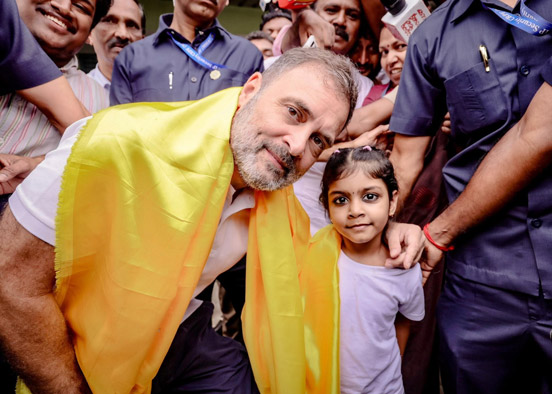
He became more accessible, more consistent in raising public issues and increasingly willing to engage directly with citizens. Instead of relying exclusively on conventional election campaigns, he chose prolonged public contact programs that gradually altered the way many Indians viewed him.
Although the Bharat Jodo Yatra became the defining symbol of this transformation, the foundations had been laid much earlier. His participation in the Bhatta Parsaul farmers' agitation in Uttar Pradesh in 2011 reflected an early attempt to move beyond elite politics and identify himself with grassroots struggles.
In the years that followed, he repeatedly highlighted issues relating to agrarian distress, unemployment, social inequality and constitutional institutions. These interventions rarely produced immediate political gains, but they established themes that would later become central to his political messaging.
How the Bharat Jodo Campaign changed the narrative
The Bharat Jodo Yatra fundamentally altered Rahul Gandhi's public image. Covering thousands of kilometres across diverse regions, the march demonstrated physical endurance, political commitment and sustained engagement with ordinary citizens.
It enabled him to interact directly with farmers, students, workers, entrepreneurs and civil society groups without the mediation of television debates or political rallies. The images of a leader walking across India, listening more than speaking, created a sharp contrast with the caricature that had dominated political discourse for years.
The subsequent Bharat Jodo Nyay Yatra reinforced this strategy by placing greater emphasis on economic justice, unemployment and social equity. While the electoral impact of these campaigns continues to be debated, they unquestionably restored confidence within the Congress organization and helped Rahul Gandhi reclaim political relevance. Equally important, they demonstrated that sustained public engagement could gradually reshape entrenched political perceptions.
Leader of the Opposition, Leader of the challenge
The 2024 Lok Sabha election marked another important milestone. Although the BJP retained power and formed the government, the Congress significantly improved its parliamentary strength, while the opposition collectively performed far better than many pre-election projections had suggested.
Rahul Gandhi emerged from the election as the undisputed Leader of the Opposition in the Lok Sabha, providing him with an institutional platform that had previously been absent.
Parliamentary interventions, frequent press briefings and consistent criticism of government policies have since enhanced his visibility as the principal national voice challenging the ruling establishment.
Unlike many regional leaders whose influence remains confined to their respective states, Rahul Gandhi now addresses issues with nationwide implications. He has consistently questioned the government on unemployment, inflation, widening economic disparities, institutional autonomy and constitutional safeguards.
His advocacy of a nationwide caste census has generated one of the most significant political debates in recent years by linking social justice with development and public policy. Whether one agrees with his position or not, he has succeeded in compelling both supporters and opponents to engage with the issue.
Beyond criticism: Offering a national alternative
However, sustained criticism alone cannot become the foundation of a successful national campaign. Indian voters have repeatedly demonstrated that they expect opposition parties to present a convincing alternative rather than merely challenge the incumbent government.
As 2029 approaches, Rahul Gandhi will increasingly be judged not only by his ability to expose perceived shortcomings in government policies but also by his capacity to articulate a coherent economic, social and governance agenda that inspires confidence among diverse sections of society.
Rebuilding Congress from the ground up
Perhaps his greatest challenge lies within his own party. Despite its improved electoral performance, the Congress remains organizationally weaker than the BJP across much of the country. Winning national elections requires a disciplined booth-level structure, motivated workers, effective state leadership and sustained grassroots mobilization.
These cannot be created during election campaigns alone. They require years of organizational investment, leadership development and local political engagement. Reviving the Congress machinery remains one of Rahul Gandhi's most urgent priorities.
Holding the Opposition together
Equally demanding is the task of managing opposition unity. The INDIA bloc demonstrated that ideological differences can temporarily be set aside to confront a common political adversary. Yet coalition politics in India has always been shaped by competing regional ambitions.
Powerful state leaders naturally seek to protect their own political space and are often reluctant to accept the dominance of any single national party. Maintaining unity among such diverse partners will require negotiation, flexibility and political accommodation rather than assertions of leadership alone.
The Kharge–Rahul equation
In this context, the working relationship between Congress President Mallikarjun Kharge and Rahul Gandhi has emerged as one of the party's significant strengths. Kharge provides organizational stability, administrative experience and institutional authority, while Rahul Gandhi functions as the party's principal campaigner and ideological voice.
This division of responsibilities has reduced internal uncertainty and projected greater coherence than the Congress displayed during several earlier phases. It also reassures regional allies that the party's functioning is not centred exclusively on one individual.
Winning New India
Another challenge awaiting Rahul Gandhi is expanding his appeal beyond the Congress's traditional support base. India's electorate is increasingly young, aspirational and focused on employment, entrepreneurship, technology and economic opportunity.
While social justice and constitutional issues remain important, voters also seek clear answers on growth, investment, infrastructure, national security and governance. The Congress leadership must therefore present a forward-looking development agenda that combines welfare with economic expansion if it hopes to broaden its electoral coalition.
Rahul Gandhi also faces the continuing task of overcoming perceptions built over many years. Political branding, whether fair or unfair, often leaves a lasting imprint on public opinion.
Although his image has undergone a remarkable transformation since the Bharat Jodo Yatra, electoral politics demands continuous performance. Every parliamentary intervention, public campaign and organisational decision between now and 2029 will contribute to shaping voter perceptions about his readiness for national leadership.
The defining three years
The next three years are therefore likely to be decisive not only for Rahul Gandhi but also for the future of opposition politics in India. If he succeeds in rebuilding the Congress organization, preserving opposition unity and presenting a persuasive governance vision, he could transform the political contest in 2029 into a genuinely competitive national election. Failure on any of these fronts would make the BJP's path to another term considerably easier.
At 56, Rahul Gandhi has already achieved something many believed impossible. He has survived sustained political attacks, multiple electoral defeats and years of relentless public scrutiny to emerge once again as a central figure in Indian politics.
That alone marks a significant personal and political achievement. But history seldom remembers leaders merely for surviving adversity. It remembers those who convert resilience into lasting political change.
Rahul Gandhi has largely won the battle for relevance. The far greater contest—the battle for public trust, organizational revival and ultimately national leadership—has only begun. The road to 2029 will determine whether his political reinvention becomes a footnote in history or the foundation of a genuine alternative in Indian democracy.
--------------------------------------------
(K S Tomar is a senior political analyst and strategic affairs columnist based in Shimla)
The views expressed are not necessarily those of The South Asian Times