By Vipul Tamhane
The Teesta handshake is the headline. The strategic architecture beneath it is the real story.
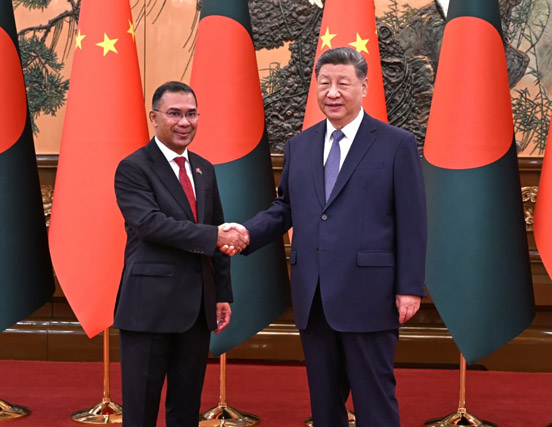
When Prime Minister Tarique Rahman touched down in Beijing on June 24, the optics were carefully handled. Thirteen memoranda of understanding, a quick handshake with Premier Li Qiang at the Great Hall of the People, pledges of solidarity on growth and sovereignty. Dhaka called it a new chapter. But for strategists in New Delhi, and indeed in Washington, the subtext of this visit will be parsed some time later, even after the ceremonial photographs have faded.
The visit was not a diplomatic revolution. Bangladesh is not pivoting away from India in the manner of, say, Myanmar's military junta or Sri Lanka under the weight of Chinese debt. Tarique Rahman's government has neither the ideological inclination nor the geopolitical luxury to abandon New Delhi entirely. What this visit represents is something subtler and, in the long run, more consequential: the deliberate institutionalization of Chinese influence across the full spectrum of Bangladeshi statecraft, economic, political, developmental, and now hydrological.
The GDI gambit
The most strategically significant outcome of the Rahman visit is not the Teesta River agreement that has dominated Indian commentary. It is Bangladesh's formal accession to China's Global Development Initiative. Proposed by President Xi Jinping in 2021, the GDI is, on its face, a multilateral framework for accelerating progress toward the UN Sustainable Development Goals.
In practice, it is Beijing's answer to the West's attempts to offer developing nations an alternative to Chinese financing, except that the GDI is itself a Chinese initiative, with Chinese institutions, Chinese priorities, and Chinese political assumptions embedded in its architecture.
For years, Dhaka remained cautious about joining. Officials signalled concern about preserving strategic neutrality. That caution has now dissolved. Bangladesh’s accession to the GDI means it has, sort of formally stepped into a Chinese-led development framework at the exact moment when the geopolitical rivalry between Beijing and Washington, and between Beijing and New Delhi, is really getting more intense across the Indo-Pacific.
This is not just a ceremonial nod or symbolic thing. It sets up institutional linkages, opens up routes for financing, and generates political duties that will steer Bangladeshi policy decisions over the coming decade.
The Teesta trap and the Siliguri shadow
The Teesta River agreement has really drawn the loudest alarm in India, and not without reason, maybe. The river runs from the eastern Himalayas through Sikkim and West Bengal, before it reaches Bangladesh, where it keeps up irrigation for millions of people. Over a decade already, India and Bangladesh have still been unable to finish a full water-sharing treaty, largely because
one government after another in New Delhi couldn’t simply override Mamata Banerjee’s objections coming from Kolkata. That political impasse has now handed China an opening.
China’s proposed engagement, river training, dredging, flood control infrastructure, embankment construction, and water-resource data systems, is put forward in a sort of neutral talk about technical cooperation, you know. Beijing has predictably insisted the project “does not target any third party”, like it’s a simple technical matter and nothing more.
That assurance should satisfy no one. What matters is not Chinese intentions but Chinese capabilities and positioning. A significant Chinese engineering and technical presence on the Teesta basin places Beijing's professionals in close geographic proximity to India's Siliguri Corridor, the narrow strip of territory, barely 18 kilometers wide at certain points, connecting mainland India to its entire northeastern region. Indian security planners do not have the luxury of assuming that hydrological data collected near this corridor will remain purely civilian in application.
India offered its own technical assistance for the Teesta basin in 2024. That offer now looks insufficient. New Delhi's failure to convert goodwill into a binding treaty, one that gave Bangladesh tangible benefits and foreclosed Chinese entry, is a strategic miscalculation that will be studied in South Block for years.
Party lines and political architecture
Beneath the headline agreements lies a development that may prove equally durable: the memorandum of understanding between the Bangladesh Nationalist Party and the Chinese Communist Party. China has long cultivated party-to-party relationships across Asia as a hedge against electoral uncertainty.
The logic is straightforward: when a government changes, the infrastructure of political relationships survives. The CPC-BNP agreement means Chinese influence in Bangladesh is no longer dependent on who sits in the prime minister's chair. Beijing is putting money into the institutional fabric of Bangladeshi politics, like the whole thing from the inside, kind of itself. This reminds you of China’s approach in Nepal, Sri Lanka, and more and more across Southeast Asia.
It’s patient, structural, and honestly not that easy to spot for a casual observer. For India, which has long gained from deep people-to-people links and civilizational ties with Bangladesh, this feels like a real qualitative step up. Economic competition, India can manage. Competing for institutional political influence inside Bangladesh's party structures is a different challenge entirely.
The Bay of Bengal calculus
To read the Rahman visit in isolation is to miss its regional logic. China already has a pretty big leverage in the Bay of Bengal’s strategic geography, like Hambantota in Sri Lanka, Kyaukpyu in Myanmar, and this web of maritime economic interests that spreads across the Indian Ocean.
Bangladesh sits in a kind of awkward but crucial middle spot between South Asia and Southeast Asia, and it controls the northeastern arc of the Bay of Bengal, so in a sense it is the missing link in this whole connectivity picture. With more Greater Chinese economic and political integration with Dhaka, Beijing gets stronger, not only for maritime trade routes but also for logistics chains, and generally for the wider Belt and Road framework.
There is no evidence of Chinese military basing ambitions in Bangladesh. But in statecraft, military basing is the last step, not the first. The sequence is economic access, then political influence, then institutional entrenchment, and only then, if strategic conditions permit, a security presence. China is methodically working through the earlier stages.
What New Delhi must do
India’s response to this visit will, in a big way, set the tone and trajectory for South Asian geopolitics through the rest of this decade. The instinct in New Delhi will likely be to express worry via diplomatic channels, push harder on connectivity promises that are already in the pipeline, and renew engagement with Bangladeshi officials. All of this is needed, but somehow still not enough.
The Teesta water-sharing agreement needs to be wrapped up. Not as some kind of favor for Bangladesh, but honestly as a strategic must for India. The longer it stays unresolved, the larger the opening it unintentionally creates for Beijing. India also needs to build a more sophisticated sort of understanding, like the real Bangladeshi agency in this whole relationship, not just a surface picture, because that angle matters.
Dhaka is not being coerced by China. It is making rational choices about how to leverage competition between Asia's two major powers to maximise its own development financing and strategic autonomy. That is a legitimate strategy, and India cannot simply demand loyalty. It should somehow make itself the more appealing partner, sort of.
The June 2026 visit won’t be remembered as the moment Bangladesh slid into Beijing’s orbit. Instead, it will stick in minds as the time China locked in another meaningful structural gain across South Asia, little by little, brick by brick, MoU after MoU, and river project on river project. The accumulation of these advances is the strategy. And India, for now, is watching it unfold.
------------------------------------------------

(Vipul Tamhane is a counter-terrorism expert and governance consultant)
The views expressed are not necessarily those of The South Asian Times