By Neha Saini & Garima Anand
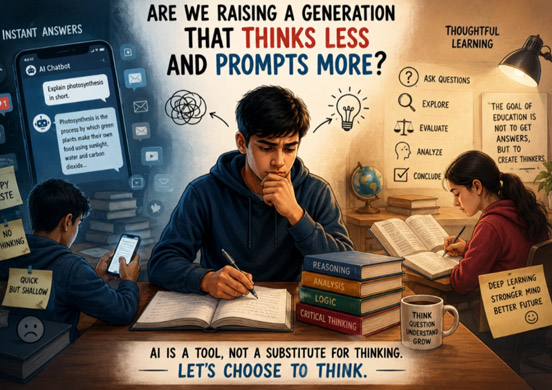
A few months ago, I asked a group of students a simple question. Instead of discussing possible answers among themselves, almost everyone reached for their phones and opened an AI chatbot. Within seconds, they had an answer.
The speed was impressive. But what caught my attention was what happened next: there was no discussion, no questioning, and no attempt to understand how the answer had been reached.
As an educator, I find myself wondering: Are we becoming so dependent on artificial intelligence that we are slowly forgetting how to think for ourselves?
There is no denying that AI is one of the most powerful technologies of our time. It can explain difficult concepts, summarize lengthy chapters, generate ideas, write code, and even help students prepare for exams. For many learners, it feels like having a tutor available 24 hours a day. But every
powerful tool comes with a responsibility. The concern is not that students are using AI. The concern is how they are using it.
Learning has never been about getting answers quickly. Think about your own school days. When you struggled with a mathematics problem or tried to understand a difficult chapter, the real learning happened during the struggle. You asked questions, made mistakes, searched for information, discussed ideas with friends, and slowly arrived at an understanding. That process
developed patience, reasoning, and critical thinking.
Today, AI can remove much of that struggle. With a single prompt, students can receive an essay, a solution, or even a complete project. While this saves time, it also raises an important question: If a machine is doing most of the thinking, what happens to our ability to think independently?
Recent studies suggest that this concern is not imaginary. Researchers at MIT found that people who relied heavily on AI tools for writing tasks showed lower levels of mental engagement and had difficulty recalling what they had written. In simple terms, when we let technology do too much of the work, our brains may become less involved in the learning process.
Many teachers are already noticing this change. Students often submit polished assignments but struggle to explain the ideas behind them. They can provide answers, but sometimes find it difficult to discuss the reasoning that led to those answers. The result is a growing gap between appearing knowledgeable and actually understanding a subject.
This matters because critical thinking is more important today than ever before. We live in a world filled with misinformation, edited videos, fake news, and endless online content. The ability to question information, verify facts, and make informed decisions is essential. If young people lose the habit of thinking critically, they become more vulnerable to accepting whatever appears convincing on a screen.
Interestingly, the skills that employers value most today are not technical skills alone. According to the World Economic Forum, critical thinking, creativity, problem-solving, and analytical reasoning remain among the most important skills for the future workforce. These are human abilities that AI cannot fully replace.
This does not mean we should fear AI or ban it from classrooms. That would be unrealistic and unnecessary. AI is here to stay, and when used properly, it can be an excellent learning companion. The goal should be to use AI as a tool for learning, not as a shortcut around learning.
Instead of asking AI to complete an assignment, students could ask it to explain a concept in different ways. Instead of copying an answer, they could challenge the AI's response, compare sources, and form their own opinions. In other words, AI should help students think more, not think less.
Parents and educators also have a role to play. We need to encourage curiosity, discussion, reading, and independent problem-solving. Young minds develop through effort. Just as muscles become stronger through exercise, thinking skills become stronger through use. The real danger is not that artificial intelligence is becoming smarter. The real danger is that we may become too comfortable letting it do our thinking for us.
As we embrace this remarkable technology, we must remember that the purpose of education is not simply to produce answers. It is to develop minds that can question, reason, imagine, and create. In the age of AI, perhaps the most important lesson we can teach our children is this: use technology
to expand your thinking, not to replace it.
(Prof Neha Saini & Dr Garima Anand are Assistant Professors with the Department of Computer Science, School of Sciences, at the CHRIST (Deemed to be University) in Delhi NCR, India.)