As India celebrates its 79th Independence Day, it stands poised to join the developed world.
By Vipul Tamhane
This Independence Day feels different. In 2025, looking at the Indian Tricolor fluttering in the breeze, it is a matter of wonder at how far India has come from those uncertain decades of years ago. The “India” that is emerging today is not just a new version of any other developing economy, but is witnessing the emergence of a true superpower, one that is giving possibilities to democracies.
Thinking back, just ten years ago, some skeptics wondered if the nation would ever shake the "emerging market" designation that was seemingly stuck with the country. But the economy currently sits above $4.2 trillion and is growing at rates that would make any economist proud. While America's growth rate lies between 2-3%, we have been maintaining 6.8% year on year. These are not just figures on a spreadsheet; they represent families moving from poverty to the middle class, electrified villages inviting industry, and young entrepreneurs who have developed billion-dollar companies from their garages.
I think the most remarkable thing about India's digital revolution is how it happened so quietly and got adopted quickly, and then suddenly it upended everything. The silent generation, who never stepped inside a bank for seventy years, now sends money to relatives using their phone. That's the power of Jan Dhan-Aadhaar-Mobile working in real time. Over 450 million people who lived outside the formal economy now have digital identities and bank accounts. The UPI system processes 12 billion transactions monthly, more than most developed countries combined.
Our startup ecosystem tells an incredible story as well. From Bangalore to Bengaluru, from towns to megacities, Indian entrepreneurs have collectively built $400 billion worth of companies. These are not cheap copies of western companies; they have solved problems unique to India, with innovative solutions that the world now wants to imitate.
Recently, until the 2000s, manufacturing was perceived to be India's weak spot, compared to China in the regional backyard. Critics said we'd missed the industrialization bus. Then came Make in India, and suddenly everything changed. Walk into any electronics store globally, and there's a good chance that the smartphone was assembled in Chennai or Noida. India produces one-sixth of all mobile phones worldwide now.
Even more impressive? Bharat has become the world's pharmacy, supplying affordable medicines to 220 countries. The Production Linked Incentive scheme brought in $85 billion in investments and created over four million jobs. Not bad for a country that supposedly could not manufacture competitively.
The infrastructure story amazes me personally because I remember those endless traffic jams and power cuts from my childhood, with the erstwhile government apologizing. In just one decade, India has built 45,000 kilometers of new highways. The Dedicated Freight Corridors are moving goods faster than ever imagined. But here's what really excites me about the infrastructure push: it's green.
Now there’s a generation of more than 200 GW of renewable energy, and it is the fourth largest producer of clean energy in the world. India’s 2070 carbon neutrality commitment encompasses our sense of responsibility to the planet, but also the nation’s desire to take a lead in getting the world on a sustainable path.
The transformations in the health and education sectors mean the most to me as an academic observer. My neighbor's cancer treatment is covered under Ayushman Bharat, a government-administered program. This was something unfathomable ten years ago, when medical debt could break an entire family. The program currently covers 550 million people and is therefore larger than the entire population of most countries.
The Swachh Bharat Mission has redefined the meaning of sanitation and public health across the country. The new education policy has transformed learning for over 400 million students. Through Skill India, the country has powered its own growth with its human resource strength by equipping 180 million young people for jobs that did not even exist at the time of their birth.
I am particularly proud of our achievements in space. When Chandrayaan-3 landed on the moon, I saw my young nephew leap into the air, filled with happiness that his country had just joined an exclusive set of nations. When the Mars mission was announced to have been successful, using a budget less than most Hollywood movies, it proved that Indian ingenuity and creativity do not require massive resource inputs; rather, amazing minds and determination. ISRO's commercial success has created an $8 billion space economy that's attracting global attention.
The financial sector cleanup deserves special mention. GST turned the previous complex, fragmented market into a single economic zone. Banking reforms brought transparency and efficiency. With foreign exchange reserves of over $650 billion, Hindustan has built genuine economic resilience. Digital banking reached 87% financial inclusion, a transformation that happened so smoothly, many people did not realize how revolutionary it was.
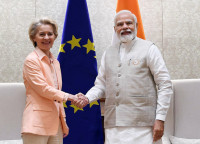
But perhaps the greatest achievement has been diplomatic. India today maintains friendships across all global divides, something that seemed impossible during the Cold War rigidity. The diplomatic prowess has now enabled India, work closely with America while maintaining historic ties with Russia. Our relationships with Iran coexist beautifully with partnerships in Israel, UAE, and Saudi Arabia. Even the Maldives recently recognized that antagonizing India serves no one's interests. Trade agreements with the EU and UK position us as a trusted democratic partner globally.
Indian peacekeeping contributions speak to the nation's character. With more than a quarter of a million peacekeepers on the ground in conflict zones globally, India has earned international credibility in putting humanity first at times of conflict and crisis, above narrow national interests. The International Solar Alliance now includes 121 countries. It demonstrates how India leads through collaboration rather than coercion. When crises happen anywhere in the world, Indian humanitarian assistance arrives quickly and without caveat.
The partnership with America is something special. Two democracies are demonstrating that freedom and prosperity are not mutually exclusive. While authoritarian regimes purport to be efficient, India and America together show that democratic tradition can deliver dignity with growth. The bilateral collaboration on defense, technology, climate action, and space exploration, through organizations like QUAD, shows how democracies can partner and influence the global order for the better.
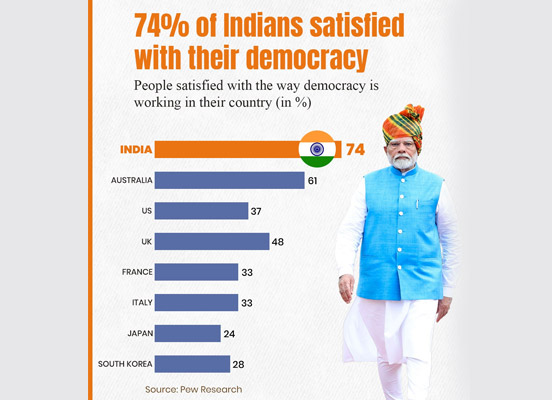
The scope of possibility is promising. India has 650 million people under the age of 25, human capital that no country can compete with. Our aim of being a $5 trillion economy in 2028 seems to be becoming more realistic. More importantly, we are demonstrating how large and diverse democracies can work and thrive in a modern world.
From an empathy-starved, newly independent nation of one million people, to a $4.2 trillion economy moving forward to number three, this journey is one of the greatest transformations in history. The Tricolor today represents not just independence achieved, but potential unleashed. India's rise isn't just her success story; it is proof that democracy, diversity, and determination can overcome any challenge.
--------------------------------------
.jpg)
(Vipul Tamhane is a counter-terrorism expert and governance consultant)
-------------------------------------------------------------
The views expressed are not necessarily those of The South Asian Times