By Basab Dasgupta
The decisive landslide victory of the BJP in the West Bengal (WB) Assembly election is a game-changer in politics. This is probably an appropriate occasion for someone like me, born and brought up in Kolkata but now living in the US, to reflect upon the significance of this transition.
Prime Minister Narendra Modi’s vision and influence will inevitably reshape the future of WB. Although I live far from India both in terms of geographical distance as well as day-to-day political events, I have been overwhelmed by Modi’s achievements during his tenure so far.
He has brought India to the verge of being a developed nation with tremendous economic prosperity. I never imagined that India would become the sixth-largest economy in the world and land a spacecraft on the moon during my lifetime. I also agree with many of his policies on international diplomacy and his intention to change the name of the country to “Bharat”.
I concur with most Bengalis that a change in regional politics was long overdue. I have been repeatedly horrified by accounts of various alleged government corruption and mismanagement throughout the tenure of Mamata Banerjee.
The list extends from Narada sting operation to more recent scandals involving college admission, teacher recruitment, smuggling of cows and coal to Bangladesh, “cut money”, rape and murder at R G Kar Medical College, death of eleven people from electrocution during flooding, and even the embarrassing mess created around Lionel Messi’s visit.
In addition, frequent allegations of torture and bullying by TMC “goons” have been consistently present. Even the veteran TMC MP, Saugata Roy, has acknowledged that “extortion at the local level” by TMC workers has contributed to its election loss.
I am excited about the present change on a more fundamental ideological level. Mamata's government focused too much on the welfare of farmers and made the state anti-manufacturing, dependent mainly on agriculture. I was shocked to learn that the plan of building an automotive manufacturing plant in Singur, Northern Bengal, by Tata was scrapped because of protests by Mamata (opposition leader at the time) on behalf of farmers.
The problem with an agriculture-centric economy is that it is weather-dependent, labor-intensive, with no significant opportunities for expansion, innovation, or modernization, and hence provides no job satisfaction.
My professional life in the American industry has taught me that the prosperity of a country is intimately related to manufacturing. Alas, there is no heavy manufacturing left in WB; jute mills on the river Ganges are dying. Hindusthan Motors is barely alive. The South City mall now stands where the Krishna Glass factory once ran.
It is no wonder that Kolkata and the entire state of WB have remained economically stagnant for decades, going back to Jyoti Basu’s communist rule. Sadly, WB has not enjoyed much of the prosperity and modernization that Modi and the BJP have brought to the rest of India.
On a personal note, it was the depressing outlook related to a bleak future and turmoil from political unrest in WB that motivated me to leave India and come to the US.
There are also concerns about the impending BJP rule. One concern is Modi’s excessive emphasis on Hindutva and what the BJP might do to erase Muslim influences. As an American, it is strange to see such involvement on the part of the government in religious affairs since government and religions are kept separate in the US by the “separation of church and state” philosophy.
A case in point was Modi’s decision to build a grandiose Ram temple in Ayodhya with unprecedented grandeur in the “Pran Pratistha” ceremony and his declaration of the future of the country as “Ram Rajya”.
The enormity and beauty of the temple, as well as the enthusiasm expressed for the temple by millions of Hindu devotees in India and the Indian diaspora all over the world, are impressive. Nonetheless, the whole episode seemed like a heavy-handed strategy on Modi’s part to officially convert India into a “Hindu Nation”.
I am certainly proud of my Hindu heritage. I believe that Hindu yogis and rishis have said it all thousands of years ago; other religions simply rehashed it in various ways. However, it is Swami Vivekananda who embodies Hinduism to me.
He said in his famous 1893 address at the Chicago parliament of religions: “We believe not only in universal tolerations; we accept all religions as true”, “As the different streams having their sources in different paths which men take through different tendencies, various though they appear, crooked or straight, all lead to thee”.
Elaborate Hindu festivities surrounding the Ram temple seem to go against the central message of Vivekananda. Construction of a multi-faith structure, making Lord Rama the central figure but also including images of other prophets, and incorporating features of temples, churches, mosques, pagodas, and gurudwaras, would have conveyed the key message of inclusivity of the Hindu religion.
I hope that the BJP does not build new temples in WB, a state where temples and religious festivities centered around Goddess Durga and Kali abound.
Furthermore, the Ram temple overshadows the Taj Mahal, the other famous attraction in Uttar Pradesh, and unquestionably the most beautiful building in the world. I wish that the town of Agra were upgraded in the same way as Ayodhya.
There is also a general concern among Bengalis that the BJP rule would bring many Hindi-speaking leaders from other states into Bengal’s politics who may not have sufficient knowledge and/or sensitivity about Bengali culture.
I do not see that as a concern if it happens. To the contrary, it would hopefully unite WB with the rest of India and encourage Bengalis to embrace the so-called “non-Bengalis”.
Bengalis are notoriously provincial and hesitant to learn the cultures and language of other parts of India, not to mention relocate outside of Bengal. I am sure that Suvendu Adhikari, a popular Bengali leader and the new chief minister, will maintain the priorities of Bengalis at the forefront. We should also remember that the roots of the BJP go back to a great Bengali leader, Shyama Prasad Mukherjee.
BJP’s victory would lay to rest all conspiracy theories that were making rounds even among Bengali communities in the US about Mamata’s hidden agenda of eventually uniting WB with Bangladesh. In fact, I expect the BJP to increase border security and minimize illegal immigration from Bangladesh, which burdens the support infrastructure in WB.
My greatest anticipation is that WB will now truly become part of the new prosperous India instead of being an odd, left-leaning region living in the past. I hope to see an influx of more industry, implementation of more technology, more infrastructure improvements, more educational and employment opportunities, as well as incentives for individual businesses with no corruption and complete transparency.
-------------------------------------------------------
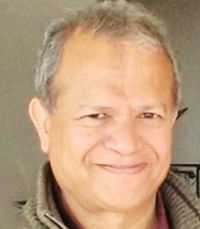
(California-based Basab Dasgupta has a doctorate in Physics from the University of Wisconsin and has worked with Sony as Vice President of an operating division.)