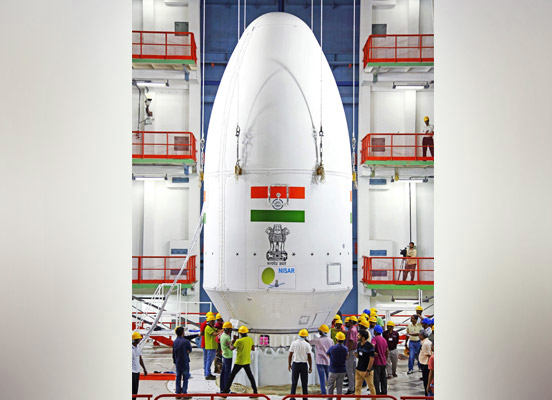
New York: In a historic collaboration between the United States and India, the NASA-ISRO Synthetic Aperture Radar satellite, also known as NISAR, is poised to revolutionize how we observe and understand our planet.
Scheduled for launch on the evening of July 30 from the Satish Dhawan Space Centre in Andhra Pradesh's Sriharikota, NISAR represents the largest joint Earth science mission ever undertaken by NASA and the Indian Space Research Organisation (ISRO). The latest NASA-ISRO collaboration follows the successful mission to the International Space Station by Astronaut Group Captain Shubhanshu Shukla.
At its core, NISAR is designed to monitor changes in Earth's surface with unprecedented precision, capturing movements as small as a centimeter. This capability is vital for tracking natural hazards such as earthquakes, landslides, volcanic activity, and glacial shifts, as well as human-induced changes like urban expansion, agricultural development, and infrastructure stress.
ISRO says the NISAR satellite weighs 2,392 kg, and it will scan the entire globe and provide all-weather, day-and-night data at a 12-day interval and enable a wide range of applications. NISAR can detect changes in the Earth's surface, such as ground deformation, ice sheet movement, and vegetation dynamics.
Further applications include sea and ice classification, ship detection, shoreline monitoring, storm characterisation, changes in soil moisture, mapping and monitoring of surface water resources, and disaster response.
The satellite's ability to operate day and night, in all weather conditions, ensures a continuous and reliable stream of data. This is especially critical for regions prone to disasters, where timely information can mean the difference between life and death. As Nikki Fox, Associate Administrator for NASA's Science Mission Directorate, emphasises, "NISAR's data will help ensure the health and safety of those impacted on Earth, as well as the infrastructure that supports them.”