By Prof. Anirban Som
Every summer, the Indian Premier League (IPL) becomes one of the biggest sporting events in the world. Stadiums fill up, streaming traffic surges, and millions across continents tune in—often at unearthly hours—to follow the spectacle. For a few weeks, routines shift, sleep schedules collapse, and even the most casual fans develop strong opinions on team selection.
But beyond the glamour and sixes lies something more profound: the IPL has quietly become one of India’s most effective instruments of soft power.
In under two decades, the IPL has transformed from a domestic tournament into a global sporting powerhouse. What began in 2008—when “streaming” still meant buffering—has grown into a league valued at around $18.5 billion, with a brand value of nearly $3.9 billion.
Its commercial strength is matched by its media dominance. The IPL’s 2023–27 broadcast deal, worth ₹48,390 crore (~$6.2 billion), is so large that even those who do not follow cricket know when it is on—because much of everything else across platforms quietly steps aside.
Its reach is equally striking. The league connects with over a billion viewers worldwide across television and digital platforms—an audience that rivals the population of most countries. On a per-match basis, the IPL competes with leading global leagues and is widely regarded as second only to the NFL in broadcast value efficiency.
Investor confidence reflects this rise. Franchises such as Royal Challengers Bengaluru and Rajasthan Royals are now valued at over $1.5 billion, signalling that the IPL is no longer just a cricket league, but a serious global sports asset.
Soft power is about attraction—the art of making others want what you have. The IPL captures this in practice, turning a cricket tournament into a vehicle of influence far beyond the game itself.
At the centre of this influence are its players. By bringing together talent from across cricketing nations, the IPL creates more than competition—it becomes a space for cultural exchange. International players spend weeks in India, travelling across cities, experiencing its diversity, and sharing dressing rooms with teammates from different backgrounds. They carry back these experiences to global audiences who follow their journeys closely.
This influence extends across continents. Fans from Australia and New Zealand to England, South Africa, and the Caribbean—and increasingly the United States—follow their favourite players on social media and engage with the stories they share. The IPL now reaches over a billion viewers worldwide, turning matches into shared cultural moments that cut across nationalities.
If the IPL is India’s soft power engine, the diaspora is what keeps it running across the world.
Spread across more than 200 countries and estimated at over 35 million people, the Indian diaspora ensures that the IPL is never confined within India’s borders. A prime-time match in India becomes a late-night ritual in London, an early-morning commitment in New York, and a stadium-like gathering in Dubai—minus the traffic.
But this is more than fandom. In key overseas markets such as the UAE, the UK, the United States, and Australia, the IPL triggers spikes in online streaming, fuels social media engagement, and brings communities together. For second-generation Indians, it often becomes a way to reconnect with family and culture—through conversations, rivalries, and shared excitement.
In effect, the diaspora turns the IPL into a global hub. It amplifies its reach, sustains its visibility, and acts as a network of informal ambassadors—armed not with policy or economics, but with group chats, watch parties, and strong opinions on team selection.
The IPL is not just a commercial success; it is a cultural force. What began as a domestic tournament has become a global platform shaping how India is perceived worldwide.
Unlike leagues such as the English Premier League or the NBA, which expanded through carefully designed international strategies, the IPL’s rise has been more organic—driven by a blend of cricket, culture, and entertainment. Its billion-plus audience and massive media footprint are not just measures of success; they are channels of influence.
That is what sets the IPL apart. It grows not through promotion alone, but through shared experience—packed stadiums, shared screens, and conversations that move effortlessly across time zones. In doing so, it presents an India that is confident, dynamic, and culturally vibrant.
In a world where perception shapes power, the IPL has quietly become one of India’s most effective instruments of influence.
(Prof. Anirban Som is an Associate Professor of Marketing at the Indian Institute of Management Tiruchirappalli (IIM Trichy), where he also serves as Chairperson of International Relations.)
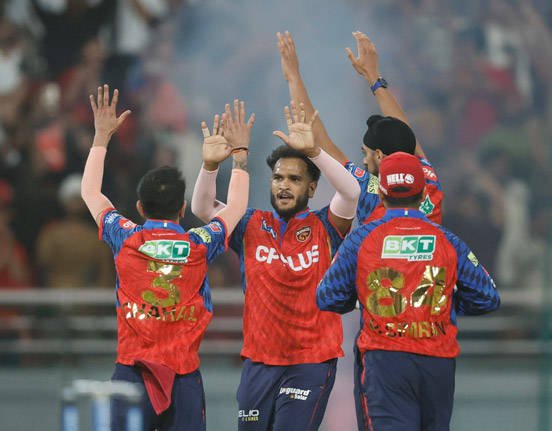
Punjab Kings register 3-wicket win over Gujarat TitansNew Chandigarh: Debutant Cooper Connolly hit his maiden half-century as Punjab Kings chased down the target of 163 runs in 19.1 overs and registered a three-wicket win, quelling a great comeback by the Gujarat Titans in their opening match of the Indian Premier League (IPL) 2026 at the PCA's New International Cricket Stadium in New Chandigarh. Chasing 163, the Punjab Kings had an early setback when impact player Priyansh Arya was dismissed for 7 off 8 balls in the second over by Kagiso Rabada. Opener Prabhsimran Singh then counter-attacked, hitting back-to-back sixes off Rabada in the fourth over. Connolly joined the charge, smashing two sixes as Punjab reached 55/1 at the end of the Power-play. The duo continued to score freely, adding 76 runs for the second wicket and taking the team close to 100. The partnership was broken in the 10th over when Rashid Khan dismissed Prabhsimran for a quick 37 off 24 balls. Captain Shreyas Iyer kept up the momentum with two sixes but was dismissed in the 13th over by Prasidh Krishna. Gujarat Titans fought back strongly with quick wickets, removing Nehal Wadhera, Shashank Singh, and Marcus Stoinis, with Krishna and Washington Sundar among the wicket-takers. |