India is not one country with one health story; it is a vast, complex nation holding multiple realities at once.
By Milind K Yadav & Arunava Acharya
India's health journey has been long and complicated. It has grown manifold since independence, and yet many steps remain. The sixth National Family Health Survey (NFHS) Fact Sheet, released this May, is full of genuinely good news. However, several areas require a more nuanced policy focus.
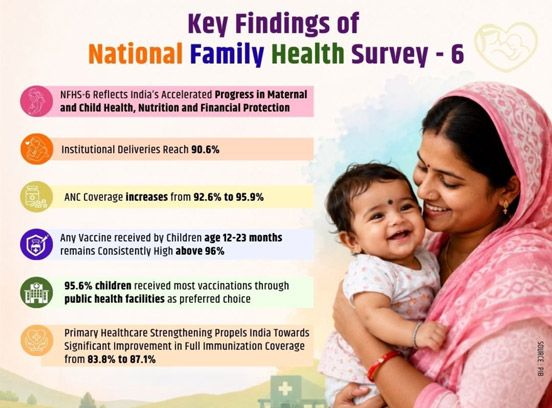
Let us begin with what we have achieved, because it is real and should be celebrated with a forward-looking approach. Stunting among children under five has fallen from 35.5 per cent in 2019–21 to 29.3 per cent today. Severe wasting, the kind that kills, has dropped from 7.7 per cent to 5.2 per cent.
Full vaccination coverage among children aged 12–23 months has crossed 82 per cent, the highest level the NFHS series has ever recorded. Over 90 per cent of births now take place in institutions attended by skilled health workers. Health insurance coverage has increased significantly, from 41 per cent of households to 60 per cent, in just 4 years.
These are not statistical footnotes. These are millions of children who did not die, millions of mothers who did not hemorrhage alone in a field, millions of families who did not have to sell land to pay a hospital bill.
And yet. The same survey that tells us children are less stunted also tells us that nearly one in five Indian women now shows elevated blood sugar or is already on medication to control it, a figure that has risen from 13.5 per cent to 17.8 per cent in four years.
Among men, it is worse: 20.9 per cent, up from 15.6 per cent. In urban India, where the lifestyle transition is furthest along, more than one in five women and nearly one in four men are diabetic or pre-diabetic. These are not soft projections about future risk. This is the present tense, measured in finger-prick blood samples from living, working Indians.
The weight data makes this legible. Overweight and obesity among women aged 15–49 have risen from 24 per cent to 30.7 per cent nationally, and to 42.8 per cent among urban women. For men, the comparable figure has jumped from 22.9 per cent to 27.3 per cent.
We are not talking about a fringe phenomenon. We are talking about a structural shift in how Indians eat, move, work, and live, and it is happening faster than our health systems were designed to absorb. The irony is almost too blunt to state: we built our health infrastructure to fight undernutrition and infectious disease, and we are now watching overnutrition and chronic disease rise on the same watch.
What NFHS-6 makes clear, above all else, is that India's health story defies simple characterization, and that is itself a sign of a maturing nation. The data offers genuine cause for celebration across the social spectrum.
Spousal violence has fallen from 29.2 percent of ever-married women to 22.3 per cent. Child marriage has declined. Women's financial inclusion has
deepened measurably. The gap between urban and rural India on maternal health indicators is narrowing, a sign that the benefits of public investment are reaching those who need them most.
Even where challenges remain, such as the dip in exclusive breastfeeding from 63.7 per cent to 55.8 per cent, or the 19.7 per cent of women who remain chronically undernourished, the survey provides the precision to know exactly where to direct attention and resources.
India is not one country with one health story; it is a vast, complex nation holding multiple realities at once, and the fact that we can now measure all of them with this degree of clarity is itself a form of progress.
What makes the NFHS-6 data so valuable is that it transforms what were once theoretical concerns into precise, actionable intelligence. For years, the non-communicable disease burden was a projection on a graph. Now it is visible in the blood sugar readings of 716,000 women, and that visibility is the first, essential step toward addressing it.
India has never been better equipped to respond. Three decades of building maternal and child health infrastructure have given the country a distributed public health network, a trained workforce, and a government with demonstrated capacity to move health indicators at scale. That same machinery can now be oriented toward the challenges of hypertension, diabetes, and cardiovascular disease, not as a replacement for what came before, but as its natural extension.
The concurrent nature of this task is not a burden unique to India; it is the defining challenge of every emerging economy that has successfully reduced infectious disease and child mortality. What sets India apart is the evidence, now richly documented in NFHS-6, that deliberate policy works. Stunting fell because of sustained investment.
Vaccination coverage rose due to a systematic effort. Institutional delivery crossed 90 per cent because governments at every level decided to do so. There is no reason the same resolve cannot be brought to primary care, preventive health and the management of chronic disease.
NFHS-6 is, above all, a map, and maps are only useful when you move. Thirty years of persistent investment have proven that India can shift its most stubborn health indicators when it chooses to. The next chapter is already written in the data: strengthen primary care to catch diabetes and hypertension before they become crises, and redirect the cesarean section conversation
toward accountability in private hospitals, and protect breastfeeding with the same urgency once reserved for polio eradication.
The tools exist. The evidence is in hand. What NFHS-6 asks of the next generation of policymakers is not imagination; it is the courage to act on what they already know.

(Dr Milind K Yadav is a faculty member at Christ (Deemed to be) University, Pune, India. Dr Arunava Acharya is an independent researcher who completed his PhD from IIT Roorkee, India.)
The views expressed are not necessarily those of The South Asian Times