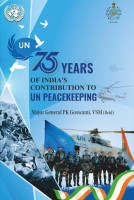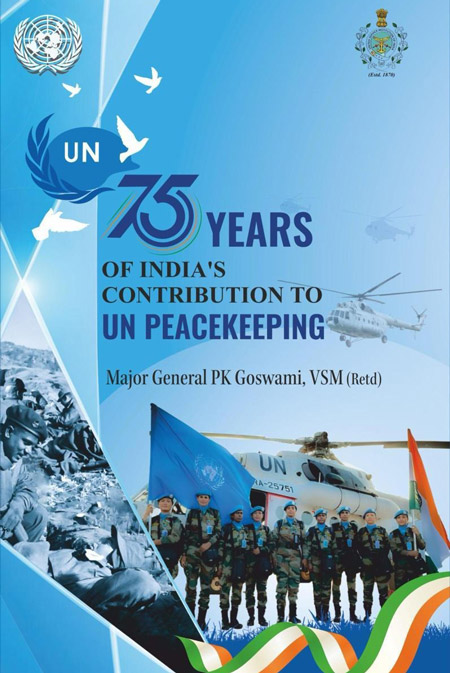
The book, 75 Years of India’s Contribution to UN Peacekeeping, attempts a comprehensive understanding of India’s role in peacekeeping over the past 75 years, from Korea in 1950 to the latest deployment at Abyei and till date. The book seeks to briefly chronicle India’s rich and multi-faceted peacekeeping journey by analysing its impact, challenges, and evolving role. This book draws on official records and personal interviews to offer a ground-up perspective on India’s evolving UN role and has seven chapters, along with seven appendices.
Indian Ethos and World Peace
It is quite evident that India is in much demand for UN Peacekeeping, due to the dedication and professionalism of our soldiers. As per the author easy acceptability of our troops by diverse communities in war-torn countries lies in our deeply rooted social, cultural, and religious ethos, which he experienced firsthand in Angola. Indian ethos is based on our ancient traditions, as enunciated in सर्वे भवन्तु सुखिनः सर्वे सन्तु निरामयाः । सर्वे भद्राणि पश्यन्तु मा कश्चिद् दुःखभाग्भवेत्, ॐ शान्तिः शान्तिः शान्तिः, लोकः समस्ताः सुखिनो भवन्तु, and वसुधैव कुटुम्बकम्, and it is pronounced but internally visible.
This remarkable heritage is deeply ingrained in the Indian character and reflected in our troops and police personnel serving in the missions abroad. As a result, Indian peacekeepers quickly understand and respect different cultures and effectively connect with local populations in mission areas. This helps in building trust, leading to greater acceptance, and maintaining peace in conflict areas, resulting in effective peacekeeping.
India’s Contribution
Since the inception of UN peacekeeping missions in 1948, India has taken part in more than 50 out of 71 UN Peacekeeping missions, with a total contribution exceeding 2,90,000 troops and nearly 15,500 police personnel, including over 5500 personnel presently deployed in nine out of eleven ongoing missions. The bravery and sacrifices of Indian peacekeepers have earned global recognition. More than 182 Indian soldiers have made the ultimate sacrifice in the line of duty, the highest among the Troop Contributing Countries, for world peace.
India has not only provided troops but also senior leadership to peacekeeping missions as well as specialised capabilities at the UN Headquarters. To date, India has contributed three Special Representatives of the Secretary General (SRSG) and a Deputy SRSG, fifteen Heads of Mission and Force Commanders, two Divisional Commanders, and nine Deputy Heads of Mission and Deputy Force Commanders, along with several Police Commissioners in various UN missions. In addition, two Military Advisors, two (including one woman) Police Advisers, and two Deputy Military Advisers to the UN Secretary General (UNSG). In fact, for all difficult and complex missions, the UN wanted an Indian SRSG/Force Commander. There is an instance when the UNSG had to write to PM Nehru for Amb Dayal to make him available for Congo, after his previous deployment in Lebanon.
Besides many national awards, even the highest Indian gallantry award, the Param Vir Chakra, was awarded to a peacekeeper - Captain Gurbachan Singh Salaria (Posthumously) for his act of bravery in Congo, in Dec 1961. Similarly, the one of the highest civilian honour, Padma Bhushan was awarded to Lt Gen KS Thimayya, for distinguished service of higher order, as chairman of Neutral Nations Repatriation Commission; and Padma Shri, for distinguished service, as well as Kirti Chakra to Major General SPP Thorat, as commander of the Custodian Force of India, consequent to declaration of ceasefire in Korean war.
Indian women have also been part of the UN peacekeeping missions since the 1960s, starting with Congo. India was the first country to deploy an all-women contingent for a peacekeeping mission in 2007 in Liberia. And today, women are part of all missions where Indian troops are deployed. Indian women's contribution to peacekeeping has been well recognised by the award of ‘Military Gender Advocate of the Year’ to two peacekeepers, and one ‘International Female Police Peacekeeper Award’, by the UN Headquarters. More women in peacekeeping means a more effective peacekeeping.
Appendices in the book give out various facts and data related to India’s contribution, vintage newspaper cuttings of various international publications, and also, a sonnet written by Brian Urqu-hart, the Executive Secretary to the UNSG, in Dec 1976, on the farewell of Major General (later Lieutenant General) Diwan P Chand from the mission in Cyprus, encapsulating his contributions.
75 Years of India’s Contribution to UN Peacekeeping draws on official records and personal interviews to offer a ground-up perspective on India’s evolving UN role.
India and the United Nations Peacekeeping: Way Forward
India’s strength lies in its capacity to undertake peacekeeping operations in any terrain, social milieu, or adverse situations, and then sustaining such operations across the globe for prolonged periods. India’s future peacekeeping approach should enhance its global standing and diplomatic influence by linking peacekeeping activities to its wider foreign policy objectives. An example is the recently conducted Chiefs Conclave of UN Troop Contributing Countries in Delhi.
As the country marks 75 years of the Indian peacekeeping legacy, it also looks ahead to the future. In an era of evolving security threats, India’s continued engagement will be crucial in strengthening peacekeeping mechanisms, promoting stability, and upholding the UN’s vision of collective security.
The book launch comes at a critical moment, when over 130 armed conflicts rage worldwide and modern peacekeeping faces unprecedented challenges – from proxy wars and terrorism to climate-driven crises. Major General Goswami’s work reminds readers that strong multilateral resolve is essential. By chronicling India’s contributions – past and present – the book reinforces the idea that global peace requires shared effort. It serves as both a tribute to fallen peacekeepers and a call to action: preserving international peace hinges on collective commitment to the UN ideal.
The book has endorsement by Jean-Pierre Lacroix, Under-Secretary-General, Department of Peace Operations, United Nations; India’s former Permanent Representative to UN, Ambassador Asoke Mukerji; former Force Commander and Deputy Special Representative of the Secretary-General in Sudan, Lieutenant General J.S. Lidder (Retd); and Dr Cedric de Coning, international experts of NUPI (Oslo), and they have lauded the professionalism and dedication of Indian peacekeepers. These endorsements underscore India’s reputation in the UN system as a reliable partner in multilateral peace efforts.
This book will serve as a valuable resource for scholars, policymakers, military practitioners, and all those interested in the dynamics of international peace and security, and inspire a deeper appreciation of India’s remarkable contributions to world peace.
Book is published by Pentagon Press LLP and available at amazon.in.
Amazon Link: UN 75 Years - https://www.amazon.in/dp/B0FX4RXZKS
About the Author
Major General P K Goswami (Retd., presently Director, USI Centre for UN Studies) is a former Military Observer in UN Angola Verification Mission and Senior Faculty at the National Defence College, New Delhi. He has 10 monographs and two books to his credit. His earlier volume, India and UN Peacekeeping: Through the Prism of Time, was released by Mr Jean Pierre Lacroix, Under Secretary General, Department of Peace Operations, UN, on 07 Oct 2022. The book under reference was released on 24 Oct 2025, on the UN Day, by Amb Asoke Mukerji, former Permanent Representative of India to the UN. The author regularly conducts Seminar/Conferences at national and international levels and also participates in events relating to UN peacekeeping.