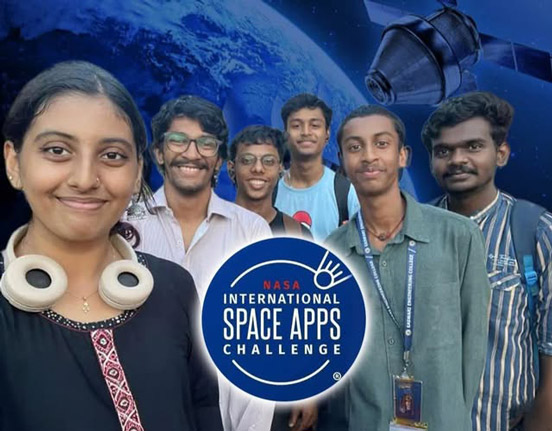
New York: An Indian team’s satellite internet concept emerged as a global winner of NASA’s 2025 International Space Apps Challenge. The Chennai-based team, Photonics Odyssey, proposed a sovereign, phased-array satellite internet infrastructure to expand broadband access across remote regions and won the Most Inspirational Award.
The project aims to reduce ground dependency and help connect more than 700 million people in India who currently lack access to broadband connectivity. The winning team members, according to NASA Space Apps, are Manish Varma D., M. Deeraj Kumar, Prasanth Gopalakrishnan, Rajalingam N., Rashi Menon., and Sakthi Sanjeev Kumar R.
NASA said the 2025 edition of its flagship global hackathon brought together more than 1 lakh, 14 thousand participants across 5 hundred and 51 local events in 1 hundred and 67 countries and territories.
Indian American students and participants of Indian origin also featured prominently among the winners, reflecting the strong presence of the Indian diaspora in global science and technology innovation.
Another winning project with Indian-origin participation was Astro Sweepers, which received the Galactic Impact Award at a universal event. The team — Harshiv T., Pragathy S., Pratik J., Sherlin D., Yousra H., and Zienab E. — developed an end-to-end orbital debris compliance and risk intelligence platform that automatically ingests public orbital data to generate debris assessment reports and compute a risk index for resident space objects.
Launched in 2012, the International Space Apps Challenge is NASA’s annual global hackathon designed to engage citizens worldwide in solving real-world problems using the agency’s open data. It has grown into one of the world’s largest collaborative platforms for STEM innovation.