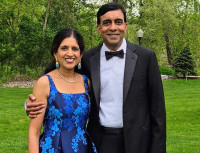
Will support pioneering initiatives centered on sickle cell disease and hemophilia
New York: California hematologist Dr. Akshat Jain has been awarded two major competitive research grants from Pfizer External Research & Grants—an achievement that places him among the nation’s foremost physician-scientists shaping the future of blood disorder care. The grants will support two pioneering initiatives centered on sickle cell disease (SCD) and hemophilia—two conditions where disparities, delayed diagnosis, and gaps in specialized care remain profound across the country.
Dr. Jain, known for his innovative work at the intersection of clinical hematology, global health systems, and emerging technologies, has led multiple national and international efforts aimed at transforming care delivery for vulnerable patient populations. These new grants will allow him to scale two first-in-kind projects:
“These projects are designed to bridge real-world gaps that patients experience daily,” said Dr. Jain. “By leveraging data, technology, and community-centered science, we can finally give families the equitable care and resources they deserve.”
These grants arrive at a critical time for California’s hematology community, where rapid advancements in gene therapy, digital diagnostics, and precision medicine require equally innovative approaches to health equity. Dr. Jain’s leadership in combining AI-driven analytics, geospatial mapping, and culturally competent education models positions these initiatives as national prototypes for future policy, advocacy, and care delivery.
Grant 1: Harnessing Geospatial Mapping to Inform Policy and Overcome Access Barriers to Sickle Cell Centers of Excellence in Southern California
This pioneering research project is dedicated to solving one of the biggest challenges for Sickle Cell Disease (SCD) patients: access to specialized care. The grant focuses on using Geospatial Information Systems (GIS) to systematically map SCD prevalence and patients' actual proximity to Centers of Excellence (COE) across Southern California.
Despite being home to one of the nation’s highest SCD populations—particularly in the Inland Empire, the desert corridor, and surrounding rural regions—patients often face long travel distances, fragmented referral pathways, and inconsistent access to specialized care. These conditions contribute to delayed treatment, preventable complications, and avoidable emergency visits.
Dr. Jain’s project uses advanced geospatial analytics, AI-generated dashboards, socioeconomic overlays, and transportation modeling to produce the first comprehensive, data-driven visualization of SCD “care deserts” across the region. By integrating hospital data, Medicaid data, census indicators, patient surveys, and real-time transportation layers, the project will create a Sickle Cell Access Equity Index, quantifying where barriers are most severe.
The study’s methodology involves analyzing anonymized state data, including hospital and Medicaid records, alongside community input from advocacy partners. By overlaying community-level factors such as social, economic, and transportation indicators, the team will identify and publicly visualize SCD “care deserts”—regions where patients must travel more than 60 minutes to reach a COE. This data-driven approach allows researchers to analyze the correlation between poor access and negative patient outcomes, such as higher emergency room and hospital utilization rates.
This project will serve as a national model for using geospatial intelligence to drive health equity—demonstrating how location-based analytics can shape public policy, reduce preventable crises, and deliver truly patient-centered care.
Grant 2: Culturally Tailored, Multidisciplinary Education Initiative for Hemophilia in the Inland Empire
Hemophilia care in the United States has evolved dramatically with the introduction of extended half-life factors, gene therapy, and rebalancing agents—but disparities in both diagnosis and disease literacy persist, especially for historically underserved communities. Dr. Jain’s second grant addresses this critical gap through a culturally responsive, community-centered education initiative tailored to the Inland Empire, one of California’s most diverse regions.
This project brings together physicians, public health educators, genetic counselors, community advocates, and patient families to build a multilingual, multidisciplinary education framework. It focuses on early recognition of bleeding symptoms, accurate diagnosis of mild and moderate hemophilia, and empowerment of women and girls with undiagnosed bleeding disorders—a population long overlooked in traditional models of care.
A central feature of the program is its integration of AI-driven learning modules, community workshops, tele-education, and mobile outreach, ensuring that education is accessible regardless of insurance status, transportation barriers, or primary language.
Its impact will include earlier diagnosis, improved provider confidence in managing complex bleeding disorders, and a stronger regional network capable of supporting advanced therapies—including curative gene-based treatments. Ultimately, this initiative will serve as a scalable blueprint for hemophilia education nationwide, particularly in multicultural and geographically expansive regions.