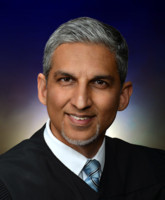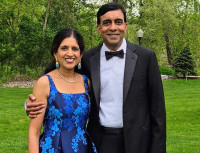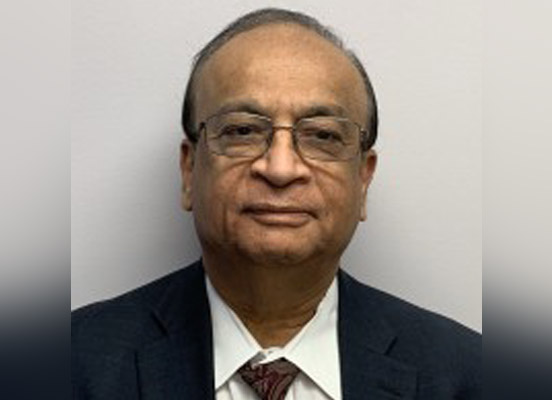
New York: Prominent Indian American physician and community leader Dr Bharat Barai has cautioned that India–US relations may remain strained in the near future unless Washington reconsiders its recent tariff measures, arguing that India has been unfairly targeted amid shifting global trade and energy realities.
Speaking on the current state of bilateral ties, Dr Barai said the momentum built over multiple US administrations had suffered a setback following President Donald Trump’s return to the White House. He attributed the deterioration largely to trade decisions that he described as politically motivated rather than grounded in sound economic policy.
Dr Barai acknowledged that the United States runs a trade deficit with India but said addressing it required a measured and strategic approach. “Imposing tariffs purely on economic grounds to reduce the trade deficit is one thing,” he said. “But slapping a so-called reciprocal duty of 25 per cent to wipe out the deficit is excessive.” He argued that a lower rate, closer to 15 per cent, would have been more reasonable and less disruptive to bilateral relations.
He was particularly critical of the additional 25 per cent duty imposed on India as a penalty linked to its imports of Russian oil. While condemning Russia’s invasion of Ukraine, Dr Barai said India had become an “innocent bystander casualty” of a policy that lacked consistency and fairness. He pointed out that China imports more Russian oil than India but has not faced similar punitive measures.
“China has a Trump card, and that Trump card is rare earth metals,” Dr Barai said, referring to US and European dependence on Chinese supplies for electric vehicles, defence systems and advanced aircraft. He also noted that several European countries continue to import Russian energy without facing additional tariffs. “There is no extra duty on countries like Hungary or Slovenia for continuing Russian oil imports,” he said, questioning why India had been singled out.
Looking ahead, Dr Barai said India–US relations could remain effectively frozen unless a trade agreement removes the additional duties. He noted that some Indian companies, including Reliance, have reduced Russian oil imports following sanctions on specific Russian firms, but said India could not entirely abandon a key energy source. “For a country of 1.4 billion people, access to reliable and affordable energy is essential,” he said, adding that Russia accounts for only about 35 per cent of India’s oil imports.
Dr Barai praised Prime Minister Narendra Modi for handling US pressure “very diplomatically” while prioritizing India’s national interest. He also said India’s global standing has improved in recent years, citing closer ties with Europe, a free trade agreement with the UK, deeper engagement with Africa and a new defence pact with Australia. “India is more respected globally than before,” he said, “except perhaps in the United States.”