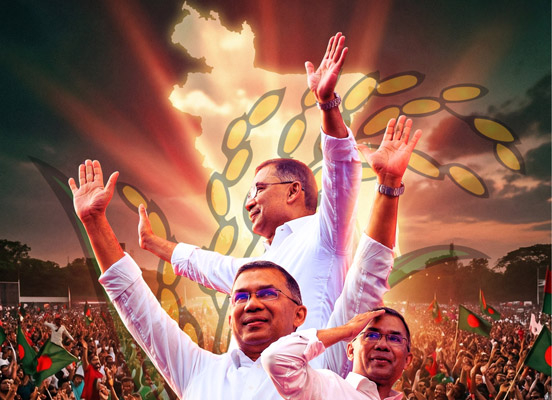
Dhaka: The Bangladesh Nationalist Party (BNP) is set for a sweeping victory in the country’s landmark parliamentary elections, with unofficial results from multiple media tallies on February 13 placing the party comfortably ahead of its rivals.
BNP congratulated the people of the country and declared victory after crossing the two-thirds majority mark in the 13th general election. The party is leading with 165 seats, with Tarique Rahman set to become the newly elected Prime Minister. The closest rival, Jamaat-E-Islami, has secured a lead in 62 seats.
Bangladesh went to the polls on February 12 to elect a government that would replace the interim administration, which took charge after the collapse of the Sheikh Hasina-led Awami League regime in August 2024.
Counting began soon after polling concluded at 4.30 pm local time on Thursday, and early tallies indicated that the BNP had crossed the halfway mark in the 300-member parliament. Reuters projected that the BNP-led coalition secured 209 seats, clinching a two-thirds majority in the Jatiya Sangsad, or House of the Nation.
The Bangladesh Election Commission (EC) is yet to make a formal announcement. An EC spokesperson said the results in several seats were still being processed and were likely to be announced in a few hours.
Voting for the 13th parliamentary elections was held alongside a referendum on the implementation of a complex 84-point reform package known as the July National Charter.
The BNP had earlier announced that if it won the election, its chairman and former premier, Khaleda Zia's son, Tarique Rahman, would be the next prime minister of Bangladesh.
Tarique Rahman has pledged to recalibrate Bangladesh’s international partnerships to attract investment without tying the country too closely to any single power.
He has also highlighted expanding financial aid for poor families, reducing reliance on garment exports by promoting industries such as toys and leather goods, and introducing a two-term, 10-year limit for prime ministers to deter autocratic tendencies.