The City University of New York’s Graduate Center and nine of its undergraduate colleges have been designated as leading U.S. research institutions in this year’s Carnegie Classifications of Institutions of Higher Education.
The influential classifications, administered by the American Council on Education (ACE) and the Carnegie Foundation for the Advancement of Teaching, maintained the Graduate Center’s top-tier designation as a Research 1 (R1) institution. Hunter College joined City College as a Research 2 (R2) institution, marking the first time two CUNY colleges have achieved that status.
In addition, seven CUNY senior colleges were named to a new classification, Research Colleges and Universities. They are Baruch College, Brooklyn College, College of Staten Island, John Jay College of Criminal Justice, Lehman College, Queens College and New York City College of Technology.
The research classifications are based on how much institutions spend on research and development each year and how many doctoral degrees they award. CUNY reports University-wide expenditures of external grant funds totaling $622 million in FY 2024, an increase of about 68% since 2014.
“CUNY’s extraordinary showing in the new Carnegie Classifications is an affirmation of our tremendous growth as a research university over the past decade,” said CUNY Chancellor Félix V. Matos Rodríguez. “Advancing scientific discovery with real-world public impact and training the next generation of researchers are both core to our mission as the country’s leading urban public university. Led by the Graduate Center, and with the growth of research at City College, Hunter College and CUNY campuses across New York City, our more than 10,000 faculty researchers and their students are conducting transformative science for the public good.”
“This is a momentous day for CUNY Research because it reflects the hard work that our researchers are putting in conducting public impact research, and the transformative growth that CUNY has boasted over the years in being the nation’s largest urban public university,” said CUNY Associate Vice Chancellor and University Vice Provost for Research Rosemarie Wesson.
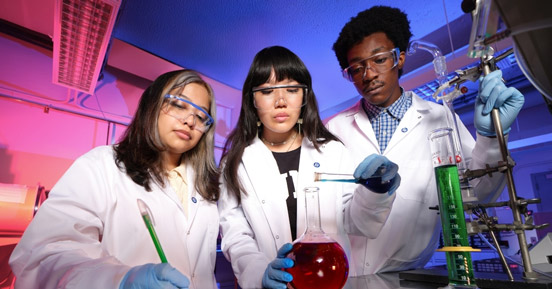
CUNY research is consequential and wide-ranging. Among the many projects at the Graduate Center is one supported by a $1 million grant from Google for a three-year project to help faculty and graduate student instructors explore how generative artificial intelligence will impact various fields. At Hunter College, researchers and their collaborators at Temple University are working on their second $13 million grant from the National Cancer Institute to address treatment disparities. And at City College, structural biologists developed a drug-testing technique that led to approval of a new treatment for specific forms of kidney, pancreatic and retinal cancers.
The Carnegie Classifications, which have been the principal framework for categorizing the nation’s colleges and universities since 1973, were updated for this year’s lists with new methodology that “better reflect the public purpose, mission, focus, and impact of higher education,” according to the organization.
Under the new criteria for research activity designations, R1 institutions have research expenditures of at least $50 million and award at least 70 research doctorates annually. The Graduate Center, one of 187 institutions awarded the R1 designation, had a three-year average annual expenditure of $57 million between 2021 and 2023 and awarded 360 research doctorate degrees.
R2 institutions spend at least $5 million on research annually and award at least 20 doctoral degrees. City College’s annual expenditures averaged $62 million in fiscal years 2021-23 and the college awarded 30 doctoral degrees. Hunter College spent $35 million a year on average in that period and awarded 20 research doctorates. They are among 139 institutions awarded R-2 designation.
Research Colleges and Universities (RCUs) is a new designation for colleges and universities that spend at least $2.5 million on research annually but have historically not been recognized for their research activity, including institutions that do not confer doctoral degrees.
In April, ACE and the Carnegie Foundation will publish their 2025 Institutional Classification, which groups institutions by characteristics including the types of degrees they award, the fields of study in which students receive their degrees and the size of the institution.
The City University of New York is the nation’s largest urban public university, a transformative engine of social mobility that is a critical component of the lifeblood of New York City. Founded in 1847 as the nation’s first free public institution of higher education, CUNY today has seven community colleges, 11 senior colleges and seven graduate or professional institutions spread across New York City’s five boroughs, serving more than 240,000 undergraduate and graduate students and awarding 50,000 degrees each year. CUNY’s mix of quality and affordability propels almost six times as many low-income students into the middle class and beyond as all the Ivy League colleges combined. More than 80 percent of the University’s graduates stay in New York, contributing to all aspects of the city’s economic, civic and cultural life and diversifying the city’s workforce in every sector. CUNY’s graduates and faculty have received many prestigious honors, including 13 Nobel Prizes and 26 MacArthur “genius” grants. The University’s historic mission continues to this day: provide a first-rate public education to all students, regardless of means or background. To learn more about CUNY, visit https://www.cuny.edu.