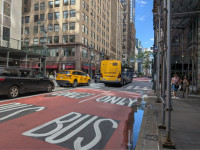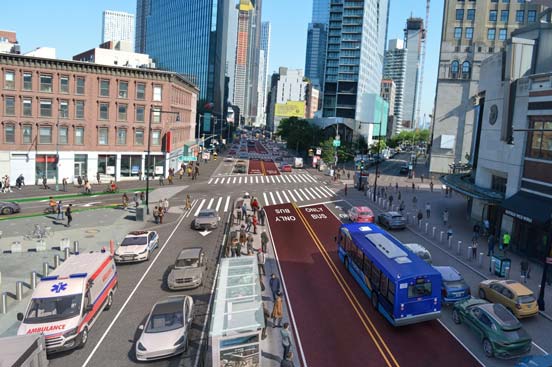
New York City Department of Transportation Commissioner Ydanis Rodriguez announced the agency will begin installing new bus lanes on Flatbush Avenue this fall, following extensive public feedback on a new block-by-block design for the corridor, running from Livingston Street to Grand Army Plaza in Brooklyn through Downtown Brooklyn, north Park Slope, and Prospect Heights. The project will deliver faster, more reliable commutes for 132,000 daily bus riders across the entire Flatbush corridor, while improving safety on one of Brooklyn’s high crash corridors. The redesign follows a robust traffic analysis that shows the project would significantly reduce cut-through traffic on Flatbush Avenue. NYC DOT expects to complete the project in 2026.
“We are excited to get Flatbush Avenue moving. Today 132,000 daily bus riders are stuck waiting too long for slow buses, drivers are caught in a mess of traffic, and pedestrians are left crossing intersections clogged with vehicles,” said NYC DOT Commissioner Ydanis Rodriguez. “These new bus lanes will speed up bus service and make the street safer for everyone.”
After extensive community engagement and incorporating public feedback, NYC DOT on Thursday evening presented its proposed block-by-block design for center-running bus lanes to Brooklyn Community Board 2. More community board presentations are to come and NYC DOT welcomes further feedback before implementation begins this fall.
Bus and Safety Challenges
Flatbush Avenue is a Vision Zero Priority Corridor, meaning it is one of the most dangerous streets in Brooklyn, with 140 people killed or severely injured within the past five years. According to MTA estimates, annual ridership of the B41, which serves nearly the entire eight-mile Flatbush Avenue corridor, is over 4.4 million riders—putting it among the 10 busiest bus routes in New York City. This high ridership is indicative of the fact that nearly 60 percent of the households along Flatbush Avenue have no access to a personal vehicle.
NYC DOT is proposing bus lanes on the northern section of the avenue, from Livingston Street to Grand Army Plaza, where bus service is currently the slowest. Serving over 132,000 daily riders across 12 bus routes, bus riders across all of Flatbush Avenue currently experience bus speeds slower than four miles per hour at rush hours—about the same speed as a pedestrian walking the corridor.
Flatbush Bus Lane Design and Implementation
NYC DOT is advancing a plan for center-running bus lanes for Flatbush Avenue between Livingston Street and Grand Army Plaza, with new pedestrian spaces to improve traffic safety and reduce pedestrian crossing distances. The project will also adjust curb regulations along commercial uses to better support local businesses' delivery needs.
The center-running bus lane design features several key elements, including:
Center-running lanes are the best option to dramatically increase bus speeds by creating physically separated spaces for buses and reducing conflicts with personal vehicles traveling the corridor. This design will allow Flatbush Avenue to move more people more efficiently than it does today. After NYC DOT installed center-running bus lanes on the Edward L Grant Highway, in the Bronx, the agency saw a decrease in pedestrian and cycling injuries by 29 percent and a reduction of total injuries by 17 percent.
With center-running lanes, NYC DOT would install concrete bus boarding islands in the street to provide safe spaces for pedestrians to board, disembark, and wait to cross the street. The boarding islands would create a train-like service experience for riders while reducing instances of speeding drivers.
Based on an extensive traffic analysis and experience from previous projects, NYC DOT expects the redesign would reduce traffic volume on Flatbush Avenue, create a welcoming corridor for pedestrians and bus riders.
The agency plans to begin installing bus lane markings and painted curb extensions this fall, with work resuming when the weather warms in spring 2026. Due to the size of the project and complexity of constructing new concrete islands, the agency expects the project to be completed in fall 2026.
“I have long advocated for improved bus transportation and to ensure that the MTA has the funding it needs to maintain and improve our public transportation system,” said Assemblymember Robert Carroll. “Thanks to DOT for moving forward with this initiative and for the advocacy organizations and community groups who have been pushing for better bus service and enhanced street safety on the vital Flatbush Avenue corridor.”
“The Flatbush Avenue bus corridor moves tens of thousands of Brooklynites who live, work and shop in Downtown Brooklyn every single day. But those bus riders are stuck on busses crawling through traffic at speeds even slower than many Brooklynites can walk,” said City Councilmember Lincoln Restler. “I’m pleased that DOT is beginning to fix Flatbush with dedicated bus lanes and center boarding to deliver the faster bus service that Brooklynites deserve.”