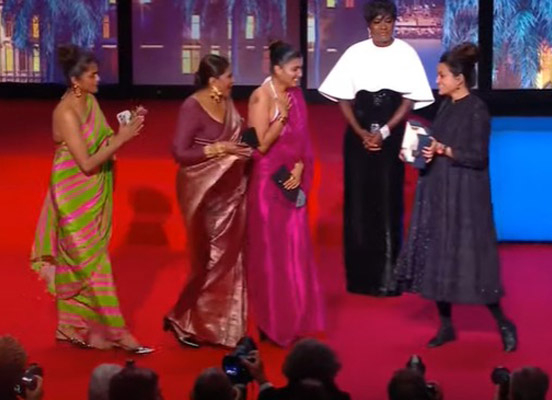
For the first time in 30 years, an Indian film, Payal Kapadia’s ‘All We Imagine as Light’ which centers around the lives of two nurses, was nominated for the Palme d’Or, the highest award in the festival. Kapadia’s film won the Grand Prix, the second position in the category.
This comes 30 years after Shaji N Karun’s ‘Swaham’ competed for the highest honor.
India’s performance at the 77th Cannes Film Festival has been no less than phenomenal with two filmmakers, an actress and a cinematographer, winning top awards.
With this win, Payal Kapadia, a FTII alumnus, becomes the first Indian to bag this prestigious award.
Kapadia’s film was granted official Indo-French co-production status by the Ministry of Information and Broadcasting, under the signed Audio-Visual treaty between India and France.
Film and Television Institute of India student Chidananda S Naik bagged the first prize in the La Cinef section for ‘Sunflowers were the first ones to know’, a 15-minute short film based on a Kannada folklore.
It is important to note that an India-born Mansi Maheshwari’s ‘Bunnyhood’, an animated film, bagged the third prize in the La Cinef Selection.
The Festival celebrated the work of the world-famous director Shyam Benegal.
After 48 years of its release in India Benegal’s Manthan, preserved at the National Film Archives of India (NFDC-NFAI under the Ministry of Information and Broadcasting) and restored by the Film Heritage Foundation, was showcased at Cannes in the classic section.
Cinematographer Santosh Sivan, known for his rich body of work in Indian cinema became the first Asian to be awarded the prestigious Pierre Angnieux Tribute award at the 2024 Cannes Film Festival in recognition of his career and exceptional quality of work.
Anasuya Sengupta became the first ever Indian to win the Best Actress award for her performance in The Shameless in the Un Certain Regard category.
Another independent filmmaker who shone at Cannes was Maisam Ali, also an FTII alumnus.
His film ‘In Retreat’ was screened at the ACID Cannes sidebar program. It was the first time an Indian film was screened in the section run by the Association for the Diffusion of Independent Cinema, since its inception in 1993.