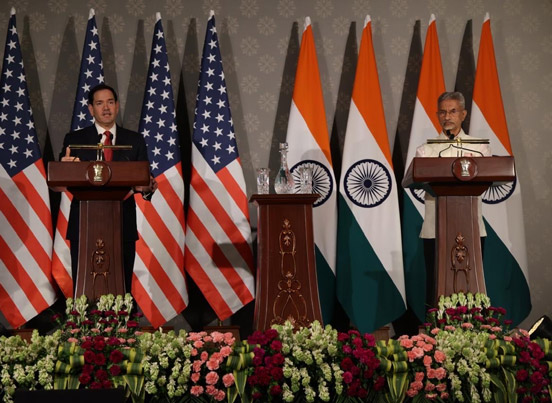
The US Secretary of State’s recent visit to India underscores the enduring strength of bilateral ties and mutual commitment to a stable Indo-Pacific, even as both nations navigate complex global challenges together.
By K S Tomar
US Secretary of State Marco Rubio’s visit to New Delhi was presented as a reaffirmation of the strong and growing partnership between the United States and India. In many ways, it lived up to that promise. Both countries recognize their shared interests in promoting peace, prosperity, and security across the Indo-Pacific region. While differences naturally exist between two vibrant democracies, the visit demonstrated a constructive spirit aimed at deepening cooperation and addressing concerns through dialogue.
The relationship between India and the United States has matured significantly over the years. Rubio’s engagements with Indian leadership reflected Washington’s appreciation of India’s rising global role and its importance as a key partner. At the same time, India continues to value American technology, investment, and support for a free and open Indo-Pacific. This visit provided an opportunity to build on these foundations while working through occasional policy differences in a spirit of mutual respect.
Navigating trade, energy, and regional stability
Economic ties formed a significant part of Rubio’s agenda. The United States and India are working to expand trade and investment in ways that benefit both economies. While tariff-related discussions have occurred, these reflect normal negotiations between major trading partners seeking fair and reciprocal arrangements. The Trump administration has shown interest in enhancing energy cooperation, with American energy exports offering India greater diversification options.
Rubio highlighted opportunities for collaboration in energy security, particularly as global supply chains face disruptions. Both countries share an interest in stable energy markets and reducing dependence on volatile regions. India’s pragmatic approach to West Asia, including its ties with various partners, complements America’s efforts to promote regional stability. Joint work on energy can strengthen resilience for both nations and support broader economic growth.
The visit also touched upon the Quad framework, which continues to serve as a platform for cooperation on maritime security, infrastructure, health, and climate issues. India and the United States, along with their Quad partners, are committed to practical collaboration that delivers tangible benefits without compromising strategic autonomy. Rubio’s meetings reinforced the idea that the Quad remains a flexible and valuable forum for addressing common challenges.
Addressing geopolitical complexities
Like any mature partnership, India-US relations involve navigating complex international dynamics. America’s engagement with various countries in the region, including occasional outreach to Pakistan during specific crises, stems from its global responsibilities. India understands that the United States must manage multiple priorities while maintaining its strong commitment to the India partnership. Both sides have worked to ensure that such engagements do not undermine their core strategic understanding.
On China, both India and the United States recognize the importance of a balanced approach. India has consistently stood firm in protecting its borders and interests, while the United States supports a free and open Indo-Pacific. Rather than creating anxiety, these parallel efforts reflect complementary strategies that contribute to regional stability. Rubio’s visit helped reaffirm that Washington views India as a vital partner in shaping a peaceful Asia, not as a substitute for direct engagement where necessary.
Differences over issues like Russia, trade, and global policies are handled through continued high-level dialogue. Rubio’s positive assessment that the relationship would emerge “much stronger” reflects the underlying resilience of ties built on mutual benefit and democratic values. India appreciates America’s role as a source of innovation and investment, while the United States values India’s growing economic strength and strategic importance.
A relationship built on mutual need and respect
The India-US partnership thrives because both nations bring unique strengths to the table. America offers technological leadership, capital markets, and defence capabilities, while India contributes a massive market, demographic advantage, skilled workforce, and strategic location. This complementarity creates a solid foundation that goes beyond immediate headlines.
Challenges remain, as they do in any important relationship between sovereign powers. However, Rubio’s visit illustrated a willingness on both sides to address concerns constructively. India continues to pursue strategic autonomy while deepening select partnerships, including with the United States. Washington, in turn, demonstrates increasing recognition of India’s independent foreign policy choices.
Looking ahead, opportunities in defence co-production, technology sharing, supply chain resilience, and clean energy cooperation appear promising. The relationship has shown remarkable growth from its earlier phases to today’s comprehensive global strategic partnership. Occasional policy frictions are natural and can be managed through the robust institutional mechanisms both countries have built.
Rubio’s meetings with Prime Minister Narendra Modi and External Affairs Minister S Jaishankar helped clear misunderstandings and opened new avenues for collaboration. As two of the world’s largest democracies, India and the United States share a responsibility to work together on global issues ranging from climate change to counter-terrorism and pandemic preparedness.
Engagement on civil society and shared democratic values
During his time in Kolkata, Rubio visited the Missionaries of Charity, paying tribute to Mother Teresa’s legacy of compassion and service. This stop highlighted the deep people-to-people connections between the two nations and the shared commitment to humanitarian values that both India and America uphold. Discussions around the Foreign Contribution Regulation Act (FCRA) were part of broader conversations on ensuring transparency in foreign funding while protecting national interests.
The Indian government has maintained that robust oversight of foreign contributions is necessary to safeguard sovereignty, prevent external interference, and ensure that funds are used for their intended developmental and charitable purposes. Like many countries, including the United States, India seeks to balance openness with responsible regulation. Both nations face the challenge of protecting democratic institutions while addressing security concerns in an increasingly complex world.
Rubio’s visit allowed for candid exchanges on these matters. The United States expressed its longstanding support for democratic freedoms, while India emphasised its commitment to an inclusive society that respects diversity. Such conversations between close partners help strengthen institutions rather than weaken them. India’s vibrant civil society continues to play an important role in its democracy, and both countries benefit from ongoing dialogue that respects each other’s sovereign choices.
In conclusion, Secretary Rubio’s visit was less about resolving every difference and more about reinforcing the enduring value of the India-US relationship. Both nations approach each other with growing confidence rather than anxiety. By focusing on shared interests and respecting each other’s perspectives, India and America are well-positioned to build an even stronger partnership that benefits not only their citizens but the wider world.
--------------------------------------

(K S Tomar is a strategic affairs columnist and senior political analyst based in Shimla)
The views expressed are not necessarily those of The South Asian Times