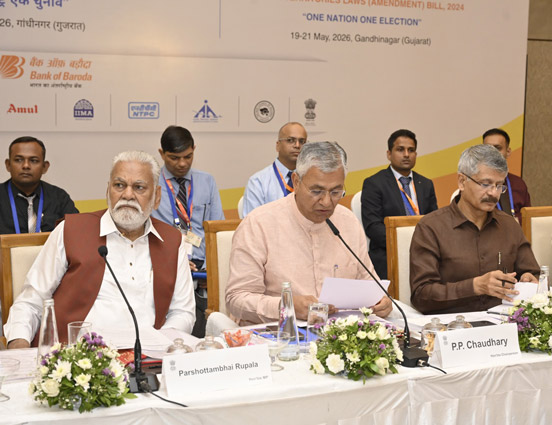
Gandhinagar: The Joint Parliamentary Committee (JPC) on ‘One Nation, One Election’ said simultaneous Lok Sabha, Assembly and local body elections could save nearly Rs seven lakh crore, improve governance efficiency and increase India’s GDP growth by up to 1.6 per cent, as committee chairperson and Lok Sabha MP P.P. Chaudhary outlined the panel’s ongoing consultations and proposed framework.
Addressing a press conference, Chaudhary said India had followed a synchronised election system until 1967, when Lok Sabha and state Assembly elections were conducted together.
“Till 1967, Lok Sabha and Assembly elections were held simultaneously. The cycle was disturbed after the premature dissolution of seven state Assemblies in 1968 and later during the Emergency period. Gradually, elections across states went out of synchronisation," he said.
He said several institutions, including the Election Commission, the Law Commission, and parliamentary committees, had, over the years, recommended simultaneous elections.
“The Election Commission proposed simultaneous elections in 1983. The Law Commission also supported the idea in multiple reports. In 2015, the Parliamentary Standing Committee on Law and Justice, headed by a Congress Rajya Sabha MP and comprising members from different political parties, also recommended that Lok Sabha and Assembly elections should be held together,” he said.
Chaudhary said Prime Minister Narendra Modi later constituted an eight-member committee under former President Ram Nath Kovind to examine the proposal.
According to him, the committee spent around 186 days preparing its report before the matter was referred to the JPC.
He said the committee’s recommendations propose synchronising Lok Sabha and Assembly elections, followed by Panchayat and Municipality polls within 100 days.
“The purpose is that the remaining time should be fully utilised for governance, development, and welfare instead of continuous elections. Every year, five to six states go to the polls, and the country remains in election mode throughout the year," he said.
“Nearly five crore laborers migrate for around a month during elections to return to their native places for voting. This affects industries, production, GST collections, and economic activity across states," he said.
He said repeated elections also affect governance because officers and departments are frequently diverted for election-related work.