
India's artificial intelligence (AI) strategy, based on Prime Minister Narendra Modi's vision of democratising technology, aims to address India-centric challenges and create more opportunities and jobs -- and 2026 is going to be a transformative year for the country which has emerged as the world’s third most competitive one in AI.
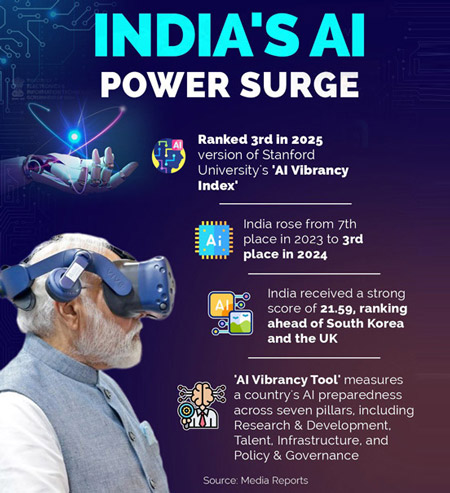
New Delhi: The country has seen AI talent concentration grow more than threefold since 2016, and now ranks among the top three countries in US-based Stanford University’s Global AI Vibrancy Tool, reflecting its growing strength in AI talent and infrastructure.
Various initiatives of the government support the development of an AI talent pipeline, like ‘IndiaAI FutureSkills,’ which is one of the pillars of the IndiaAI mission, where focus is on developing AI talent and a research pipeline.
(Photo courtesy: X@BJP4India)
The government informed that AI may result in job creation in various streams like data science and data curation, and so far, 8.65 lakh candidates have enrolled or trained in various courses, including 3.20 lakh candidates in AI/Big Data Analytics technologies.
The IT Ministry has initiated ‘FutureSkills PRIME,’ a programme for re-skilling/up-skilling of IT manpower for employability in 10 new/emerging technologies, including AI.
Under this program so far, over 18.56 lakh candidates have signed up on the Future Skills PRIME Portal, out of which, more than 3.37 lakh candidates have completed their course, according to Minister of State for Micro, Small and Medium Enterprises, Shobha Karandlaje.
As per a recent Nasscom report titled “Advancing India’s AI skills”, the AI talent in India is expected to grow from 6 lakh–6.5 lakh professionals to more than 12.50 lakh professionals by the year 2027, at a 15 per cent compound annual growth rate (CAGR).
India’s growing AI talent base is also reflected in global developer participation. As per global data on GitHub AI projects by geographic distribution, India was the second-largest contributor worldwide in 2024, accounting for 19.9 per cent of all AI projects.

The IndiaAI Mission is a major step toward building AI capabilities and driving economic growth. (Photo courtesy: X@AshwiniVaishnaw)
This underscores the depth of India’s AI developer ecosystem. It also validates the Government’s focus on large-scale AI skilling, research and innovation under the IndiaAI Mission, according to Union Minister for Electronics and IT, Ashwini Vaishnaw.
The government is also supporting 500 PhD scholars, 5,000 postgraduates and 8,000 undergraduates for AI-related work.
IndiaAl Data and AI Labs are established in Tier-2 and Tier-3 cities through NIELIT to conduct coursework in AI, data curation, annotation, cleaning and applied data science. Moreover, 174 lTIs and Polytechnics across 27 states/UTs have been approved to set up additional IndiaAl Data and AI Labs.
India among highest AI adopters globallyNew Delhi: India is among the highest AI adopters globally, and leads with 53 points on the ‘AI Advantage’ score, developed to quantify the real impact of AI at work by measuring how much time employees save, while the global average score sits at 34 points. Around 62 per cent Indians are using GenAI at work regularly, whereas 90 per cent employers and 86 per cent employees believe that AI impacts productivity positively, a recent report showed. Also, 75 per cent employees and 72 per cent employers believe that GenAI enhances decision making, 82 per cent employees and 92 per cent employers believe it positively impacts quality of work, said the ‘EY 2025 Work Reimagined Survey’. India also holds a 'Talent Health' score of 82, the highest among all geographies assessed. |
Amazon, Microsoft, Google bet big on IndiaNew Delhi: India is rapidly emerging as one of the world’s most attractive destinations for artificial intelligence (AI) investments, with three global technology giants Amazon, Microsoft and Google have announced $67.5 billion commitments to build the country’s digital future. US e-commerce leader Amazon has unveiled plans to invest more than $35 billion in India by 2030, strengthening what it calls its three strategic pillars -- AI-driven digitisation, export growth and job creation. Microsoft has announced an equally ambitious move, committing $17.5 billion over four years (2026–2029) to scale up cloud and AI infrastructure, expand skilling programmes, and strengthen sovereign-ready digital capabilities across India. Google has also made a major commitment, announcing a $15 billion investment to build a world-class AI hub in Visakhapatnam (Vizag). |