By Vipul Tamhane
New Delhi welcomed Rubio’s visit with warmth; you could feel it, and yet behind those handshakes, there is a tougher question: Is America really ready to treat India as a true strategic partner, not just a handy counterweight…?
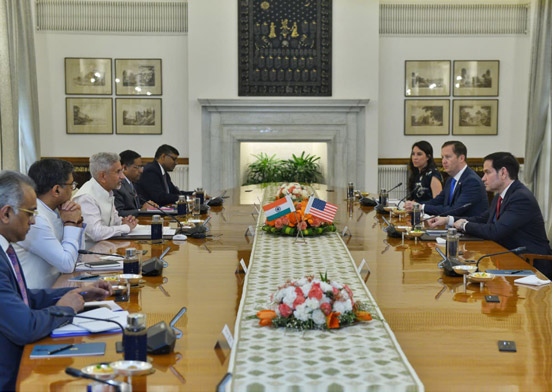
When Secretary of State Marco Rubio touched down in New Delhi, days after President Trump wrapped up his Beijing summit, and Vladimir Putin made his own little peaking in the Chinese capital; the signals suddenly clarified. The most powerful nation on earth had spent real diplomatic capital courting its closest strategic rival, then dispatched its top diplomat to reassure the country whose long-term cooperation matters most for the framework Washington is assembling across Asia.
India noticed, as it’s always noticing. New Delhi received Rubio with warmth India’s diplomatic manner is known for, visible even from a distance. Yet under that graciousness, there is a tougher concern, asked more openly lately: is the United States actually invested in India as a first-rank partner, or is New Delhi just Washington’s “safety net”, pulled out when China needs balancing and stashed when convenience says it’s fine. This question matters for every strategic goal the United States keeps in the Indo-Pacific, and American observers would be smart to grasp how India reads this moment.
The Beijing visit through Indian eyes
From New Delhi’s vantage point, the Trump-Xi summit felt less like a bilateral management and more like a signal about American priorities, read with the precision of non-alignment politics made almost automatic. The worry is not that America and China resolved their contradictions; they didn’t. The worry is thinner: that Washington’s appetite for managed coexistence, powered by economic interdependence, could chip away at the strategic sharpness Indo-Pacific arrangements need.
A United States treating China as manageable rather than a systemic rival will invest less in the QUAD architectures that give India’s centrality practical weight. Putin’s visit compounded that reading. For India, which sources most of its defense equipment from Russia and cultivated Moscow as a buffer for decades, a Russia subordinate to Beijing is a Russia whose neutrality can no longer be assumed. The Eurasian consolidation visible in these visits makes the American partnership not just attractive but structurally necessary.
Rubio’s visit was the right instinct. But instinct is not strategy. If not for Putin’s Beijing trip, would it have happened at all? The people won’t know, unless a pre-visit manifesto gets declassified, which it won’t!
What India actually needs from Washington
On strategic alignment: India’s multi-alignment doctrine, maintaining productive relationships with the United States, Russia, the Gulf states, and ASEAN simultaneously, is not fickleness. It is the rational strategy of a civilisation-state that has survived great-power competition for centuries by refusing subordination.
Washington needs to accept this as permanent, not a transitional phase. What India expects is reciprocal respect: stop treating its Russian energy purchases and defense procurement as irritants (read sanctioned at political whims), and understand them as structural inheritances of a country actively diversifying. Sanctioning India over this would be self-defeating at a moment when Washington needs New Delhi more than ever.
On defense: The defense partnership is where the relationship has genuine transformative potential and genuine unfulfilled promise. Co-production agreements, joint technology development, iCET expansion, and deeper intelligence sharing are not commercial transactions; they are the architecture of strategic trust. India needs American technology; America needs Indian scale, geography, and industrial capacity.
The logic is overwhelming, but execution has been chronically slower than ambition. Washington must bring the same urgency to India as to Japan and South Korea: quicker transfer approvals, real co-production, not licensed assembly, and capabilities historically held back for NATO allies. India may not be NATO, but it may be more consequential than several that are. And stop funding the military of the Islamic Republic of Pakistan, period!
On trade: This is where the relationship is most visibly underperforming. The lack of a trade framework between the world’s largest democracy and its oldest partner is a strategic anomaly nobody fixes. American protectionist instincts and India’s market access sensitivities have kept bilateral trade under its structural potential. When both countries want supply chain resilience outside Chinese systems, failing to build a trade architecture is not just economic inefficiency; it is strategic vulnerability.
An agreement, or at least a supply chain arrangement covering semiconductors, critical minerals, and pharmaceuticals, would do more in a decade than any pile of summit communiqués. India has signalled seriousness. Washington needs to match it with commitment, not postponement.
On technology and the digital order: Both countries face the same root challenge: Chinese dominance of critical technology supply chains, from semiconductors and rare earths to undersea cables and telecom. India’s semiconductor ambitions, digital infrastructure, and talent pool make it a natural partner. Collaboration on AI governance, chip fabrication, clean energy, and cyber security is shared civilizational self-interest, even if that’s not how it gets sold publicly.
The partnership that this moment demands
The India-US relationship has been described as “the defining partnership of the 21st century.” What it has not become is a relationship that matches that description operationally.
India isn’t asking Washington to pick a side. It gets that America’s economic ties with China are structural. What India asks is to be treated as a partner where equities are taken seriously, where strategic autonomy is respected rather than quietly resented, and where long-term importance shows up in the quality of commitment, not the timing of visits calibrated to manage Beijing anxiety.
Trump in Beijing, Putin following, and Rubio in New Delhi showed the real stakes. India is the only democratic force of continental scale that can serve as a long-run counterweight to Chinese regional dominance. Remove India from the picture and the Indo-Pacific becomes a talking point with no anchor. Washington has long understood this intellectually. The challenge now is to demonstrate it operationally, in technology transfers approved, trade frameworks negotiated, sanctions waivers granted, and the seriousness with which it engages its greatest untapped asset.
India is watching. And India, as history has shown, has extraordinary patience, but it does not wait forever.
------------------------------------------------------
(Vipul Tamhane is a counter-terrorism expert and governance consultant)
The views expressed are not necessarily those of The South Asian Times