By Vipul Tamhane
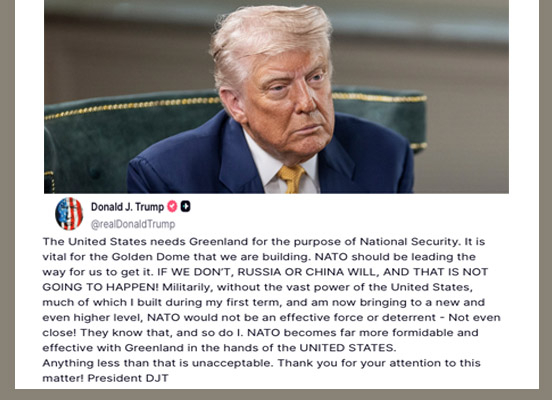
Nowhere does tension show more clearly than in President Donald Trump’s latest attempt to claim Greenland. Open talks about buying it have begun, though officials will not exclude using force. A place long aligned with US interests without conflict now faces uncertain pressure. Beyond strong words, few real choices exist for gaining control. Only three routes appear possible, with each tangled in deep difficulty.
Option 1: Military action
Asked about the possibility of using armed forces to acquire Greenland, the press secretary offered a revealing answer, i.e., strategic decisions are not publicly disclosed by this administration. That silence suggests one thing: force could still be considered.
Facing facts changes nothing about legality. Any armed operation breaks established international rules, along with American statutes. Without Congress agreeing, presidential power stops short, especially for invasions and long-term control abroad, which now seem beyond reach politically. Even Mike Johnson, known for backing Trump without hesitation, called the forced annexation of Greenland unacceptable. That stance matters. Senator Tom Tillis was even more blunt in saying, "We can do it without taking over a NATO country. And I'm sick of stupid."
A move by the Senate aims to halt military operations targeting Greenland, as one member stated clearly: "No more forever wars." Given how close lawmakers came to stopping involvement in Venezuela, attempting to invade a NATO partner would meet overwhelming resistance. Though rare, such firm rejections shape policy just as much.
Yet the political fallout dwarfs any legal hurdles. Greenland belongs to Denmark, but also sits within NATO, shielded by collective security guarantees. If the United States launched a military move, allies could be bound to resist Washington on Copenhagen’s behalf. In reality, few if any would act, and therein lies the deeper issue. The alliance would collapse not from war, but from betrayal visible at its core.
A shift like that ripples outward. Should American forces lose their footing in Europe, long-held military advantages would dissolve overnight. Some nations may break away completely, building defense ties among themselves, leaving the United States on the outside.
Trade worth trillions changes hands each year between the EU and the US; suddenly, none of it is guaranteed. Repairing trust after such a rupture? That burden likely stretches far beyond any living generation. Few actually think Trump would attack Greenland. Still, just raising the idea has weakened unity among allies and shaken confidence in US promises. Using such threats comes at a steep price. Pursuing them makes little sense.
Option 2: Purchase
A different idea seems fairer, i.e., purchasing Greenland directly from Denmark. History shows such moves are not without example. Large parts of US land came by way of payment, viz., the Louisiana Territory bought from France, Alaska acquired from Russia, among others, during the 1800s. While some deals followed pressure, many resulted when nations with funds met countries short on money.
What if Denmark agreed to negotiate a sale? Right now, officials firmly oppose such an option. Suppose, though, that financial strain or diplomatic demands shifted their stance. Challenges would still stand in the way, that to serious ones.
Though the president holds the power to strike foreign agreements or buy land, spending funds or moving assets needs approval from lawmakers. A pact arranged by Trump with Denmark would carry no legal weight unless backed by Congress. Ratifying global treaties demands a two-thirds Senate majority, as outlined in the Constitution, making approval unlikely for contentious moves like acquiring populated regions from allies.
Beyond the legal hurdles sits an essential moral issue, i.e., Greenland is not empty territory, nor a colony passed like property between rulers. Home to 56,000 individuals, it holds self-rule, distinct traditions, and growing ambitions for sovereignty. Transfer by Denmark would be impossible, just as unthinkable as selling its capital city. Agreement from those living there would be necessary.
Most Greenlanders clearly reject the idea. Although more than half support leaving Denmark, nearly 85 per cent do not wish to join the United States. What drives their aim is self-rule, not exchange of one authority for another. Buying the territory, regardless of legal feasibility, would face strong ethical and political resistance.
Option 3: Free association
A different path, now gaining attention, involves what resembles past agreements. Though calling it practical might depend on perspective, some American policymakers are discussing a Compact of Free Association. This model already exists with certain Pacific countries, such as Palau and the Marshall Islands. Under these deals, Washington gains defense rights and regional influence. At the same time, those regions keep self-governance and receive economic aid.
A shift involving Greenland hinges on several steps unfolding in order. Should residents choose, they could call a vote on leaving Denmark, a right granted after 2009. If approval follows, talks about disengagement would begin. Instead of full sovereignty, the outcome might be a close tie with the US, subject to another public decision.
Clearly, the issue stands out: people in Greenland seek complete self-rule, not closer ties to the United States. Yet one way the Trump government could shift that stance exists, i.e., through financial offers. Substantial funding might change minds.
With only 56,000 people living in Greenland, a payment of one million dollars per resident adds up to about $56 billion. That sum sits below one per cent of what the United States spends each year. Overnight, such an offer could make everyone on the island a millionaire.
For officials in Washington, this amount might seem small compared to gaining influence over Arctic territories. Still, such plans depend on Congress approving funds, something which is uncertain at best.
Buying support from Greenlanders might not work either. Agreement from Denmark remains a hurdle too. Setting up basic systems for self-rule would demand many billions beyond that. What stands out is how this method feels quietly manipulative, i.e., by offering money in exchange for national self-determination, framing public opinion as something that can be bought. Legality aside, it clashes with the spirit of self-governance. Unsettling, really, when decisions meant to reflect collective choice are shaped by financial deals behind closed doors.
The real motive
What really matters might not be Trump’s choice, but the reason behind his interest. Crucial Arctic monitoring for missile alerts comes from Thule Air Base, already under US control. For eighty years, Denmark has worked alongside America without major conflict. Expansion of military reach or resource exploration could happen through mutual deals. The existing setup offers what Washington requires.
What makes Greenland seem important is its rare earths and oil, which are harder to access than it looks. Despite interest, no mining operation has managed to extract rare earth elements at scale. Oil exploration lost its chance after a government decision stopped drilling in 2021.
When looked at closely, the idea of immediate resource advantage falls apart. This situation probably centers on pressure tactics, i.e., to push a hard talk to gain advantages in resources, troop placement, and geopolitical stance while stopping short of outright takeover. Yet pressure only works if threats seem believable; even idle ones aimed at NATO partners still cause harm just by existing.
One path open to Trump involves using troops; that choice risks shattering NATO. Buying the island runs into walls, with laws, politics, and realities impossible to bypass. A loose partnership needs approval, yet no offer tempts Greenlanders enough to agree. Leftover talk? Just sound without substance: risky chatter stretching alliances thin, possibly winning small wins while weakening vital ties. Noise stays behind when real options fade. A move like Greenland shows what happens when ambition becomes obsession, certain values resist price tags, while trust often outweighs victory.
---------------------------------------
(Vipul Tamhane is a counter-terrorism expert and governance consultant)
The views expressed are not necessarily those of The South Asian Times