By K S Tomar
Donald Trump’s China visit reflected an evolving global balance in which both Washington and Beijing appeared interested in managing competition through dialogue, with important implications for India and the wider Indo-Pacific region.
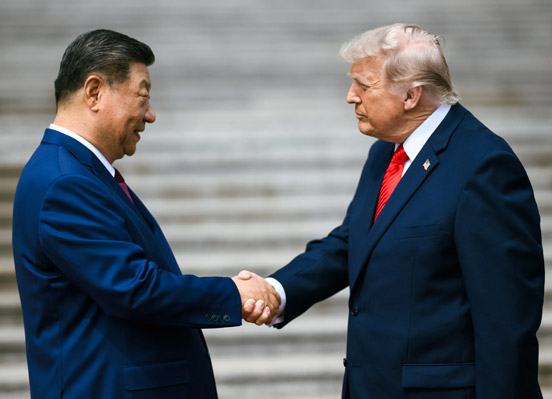
US President Donald Trump’s visit to Beijing may eventually be viewed as an important moment in the evolution of global politics, not because it resolved all differences between the United States and China, but because it highlighted the growing importance of dialogue between the world’s two largest powers during a period of international uncertainty.
At a time when the global economy faces pressure from geopolitical tensions, energy concerns, and slowing growth, the summit reflected a shared recognition that sustained confrontation between Washington and Beijing would benefit neither side nor the wider international system.
The visit came amid multiple international challenges confronting the United States, including instability in West Asia, concerns over global trade, and continued economic anxieties at home. In that context, Trump’s outreach to China appeared less an abandonment of American strength and more an effort to stabilize strategic competition while protecting long-term American economic and geopolitical interests.
The Beijing summit was therefore not simply another diplomatic engagement. It represented an attempt by both countries to prevent rivalry from escalating into deeper instability. Trump sought cooperation with China on trade, maritime security, energy stability, and regional tensions linked to Iran. The discussions also reflected Washington’s broader effort to maintain open communication channels with Beijing even while major disagreements remain unresolved.
A shift from confrontation to managed competition
One of the clearest messages from the summit was that both sides now appear more willing to manage differences through negotiation rather than public escalation. Trump, who during earlier phases of his presidency strongly emphasized tariffs and economic pressure on China, adopted a more measured tone focused on stability and economic predictability.
This does not necessarily suggest weakness on America’s part. Rather, it reflects growing recognition in Washington that the global economy is too interconnected for prolonged instability between the United States and China. American policymakers increasingly understand that responsible management of competition may serve US interests better than unchecked confrontation.
At the same time, China projected confidence in presenting itself as a major global actor prepared to engage Washington on issues ranging from trade and technology to energy security and regional stability. President Xi Jinping repeatedly stressed the importance of “strategic stability” and constructive engagement.
Both countries also agreed on the importance of keeping the Strait of Hormuz open amid tensions involving Iran. That consensus carried significant importance because disruptions in the region directly affect global energy markets and economic stability worldwide.
Taiwan remains a sensitive issue
Despite the constructive tone of the summit, differences over Taiwan remained substantial. Xi reiterated Beijing’s long-standing position that Taiwan remains central to China’s national interests. However, the discussions avoided the kind of sharp public confrontation that has often characterized recent exchanges between the two powers.
The White House appeared careful not to allow the Taiwan issue to dominate the summit, instead placing greater emphasis on trade, investment and economic cooperation. Many observers interpreted this as part of a broader American effort to maintain regional stability while continuing strategic competition with China.
For Asian countries, including India, the summit reinforced the reality that the United States and China may increasingly seek mechanisms to manage rivalry without allowing disputes to spiral into open confrontation.
Economic cooperation still matters
Trade and economic issues formed a major component of the discussions. Both sides spoke positively about expanding cooperation, reducing friction and improving market stability. While underlying competition between the two economies certainly remains, the summit suggested that Washington and Beijing are both interested in avoiding severe economic disruption.
The participation of major American business leaders, including technology and investment executives, highlighted the continuing importance of economic interdependence between the two countries. Discussions reportedly included technology access, artificial intelligence, semiconductors, energy cooperation, and supply-chain resilience.
For the United States, maintaining economic engagement with China while protecting critical strategic interests appears to be emerging as a more balanced approach than complete economic decoupling. The administration’s willingness to keep trade dialogue active reflects recognition that global growth and financial stability still depend significantly on US-China economic cooperation.
Implications for India
For India, the Trump-Xi engagement carries important strategic implications. Over the past several years, India has benefited from closer ties with the United States in areas such as defence cooperation, advanced technology, semiconductor investment, and Indo-Pacific coordination.
However, a more stable US-China relationship does not automatically reduce India’s importance. In fact, India may continue to gain from being viewed as a trusted democratic partner, a growing economic power, and an increasingly important manufacturing destination.
New Delhi is likely to study carefully any future developments involving trade arrangements, technology cooperation, or supply-chain shifts between Washington and Beijing. India has positioned itself as a key alternative manufacturing hub under the “China Plus One” strategy, and policymakers will naturally seek to preserve that advantage.
At the same time, India also benefits from a stable international environment. Reduced tensions between the United States and China can support global economic growth, lower energy uncertainty, and create more predictable geopolitical conditions for emerging economies.
A new phase in global diplomacy
Perhaps the broader significance of the summit lies in what it revealed about the changing nature of international politics. Both Washington and Beijing appear increasingly aware that competition between them must be balanced with cooperation on issues that affect global stability.
Xi invoked the importance of avoiding great-power confrontation and called for both countries to “join hands to create the future.” While strategic rivalry certainly remains, the language used during the summit suggested that both sides understand the dangers of prolonged hostility.
The United States, despite its continuing global influence, appears increasingly focused on building stability through diplomacy and partnerships rather than confrontation alone. China, meanwhile, continues to present itself as a rising global power seeking a larger role in international affairs.
Stability over escalation
In the end, Trump’s Beijing visit may be remembered less as a dramatic geopolitical breakthrough and more as an effort to prevent growing tensions from destabilizing the global order. The summit did not eliminate deep differences between the two powers, but it demonstrated that both sides still recognize the value of engagement.
For America, the visit reflected a pragmatic approach aimed at protecting economic stability, maintaining global influence, and preventing strategic competition from becoming uncontrollable. For China, it provided an opportunity to reinforce its image as a major international actor willing to engage constructively with Washington.
For countries like India, the summit served as a reminder that the global balance of power is evolving toward a more complex and interconnected order in which diplomacy, economic cooperation, and strategic flexibility will increasingly shape international relations.
---------------------------------------------------

(K S Tomar is a strategic affairs columnist and senior political analyst based in Shimla)