By Krishan Sharma & Nida Rahman
Stability in South Asia will come from a leadership that listens and leads by showing what is possible.
It took less than 36 months for South Asia to witness something that could take decades to show: an economic collapse in Sri Lanka, a mass uprising in Bangladesh, and a political meltdown in Nepal. The shifts in the South Asian region uncovered, one by one, and surprised onlookers. Governments that once appeared unshakeable abruptly faced public outcry. This rage, to everyone’s surprise, came not from opposition parties or ideological movements, but from young citizens, signalling their discontent over the ruling parties ignoring them.
The discontent was simmering for a long time, strongly entrenched in government failure to deliver jobs, economic security, and mobility. In 2024, youth unemployment in South Asia trended upward at more than 20 per cent, against around 13 per cent globally. Given that the youth today is better informed and digitally connected, coupled with their dominance on major social media platforms, they are unwilling to accept misgovernance.
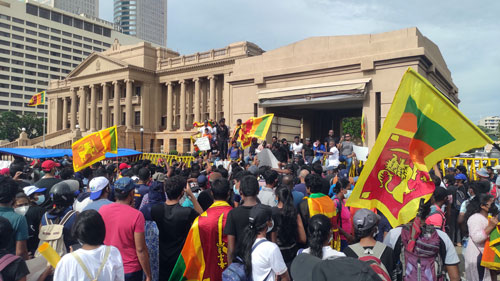
The 2022 anti-government protest in Sri Lanka. (Photo courtesy: Wikimedia Commons)
Post 2020, each year exposed the South Asian region’s misery more. In Nepal, Sri Lanka, and Bangladesh, the political ground has shifted in ways few predicted even five years ago. The upheavals are a reminder that governance failures don’t remain contained for long. Sooner or later, they spill out into the streets, eventually engulfing the region.
Amid these convulsions, India, the world’s oldest democracy and the largest economy in the neighborhood, finds itself in a position where its choices will matter more than ever.
South Asia’s troika of crisis: Similar fault lines, different facade
Although the triggers differed, each crisis in South Asia of late, erupted from the same underlying fractures: eroding institutions, shrinking economic opportunities, and a young citizenry unwilling to wait for change.
Sri Lanka’s triple crisis of debt, inflation, and shortages spiralled into a national breakdown in 2022. The result was not just a political shift, but a public demand for systemic change. The massive protests unified students, professionals, and trade unions, furious with economic mismanagement and nepotistic governance.
In Bangladesh, protests over job-quota policies among students evolved rapidly into a broader uprising against authoritarian rule and entrenched elite domination. Youth demanded fairness, transparency, and a breathing space for dissent. The movement shook the foundations of the existing political order and ended with a radical change in leadership, emphasizing that generational discontent can overturn established systems.
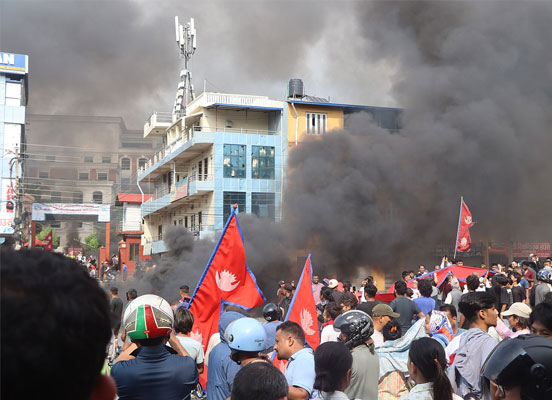
Nepal’s crisis took a different form and face through the denial of digital freedoms. A government order to ban major social-media platforms triggered a digital uprising among Generation Z. Young people took to the streets and online platforms, protesting not just the ban, but years of neglect, inequality, and corruption. Their outcry forced a government collapse. In Kathmandu, public anger translated into rapid political change, showing how digital-age activism can reshape governance.
Between the cracks: South Asia’s deepening governance crisis
When we look at Sri Lanka, Bangladesh, and Nepal together, a pattern becomes undeniable. Public anger in each country was not rooted in ideology, but in a sense of betrayal long felt by youth, by institutions that promised fairness, by political systems that delivered stagnation, and by elites who treated power as inheritance.
These events show that South Asia is undergoing a transition not defined by traditional politics, but by a generation asserting demand for accountability. Institutions that once held societies together are now hollow; legitimacy is no longer assumed. Above all, a young population, which is digitally connected, aware, is no longer willing to endure misgovernance.
Positioning India as the stabilizing force in the crisis-entrenched South Asia
India has often decisively stepped into pivotal roles during regional crises before. Through various regional programs, focusing on economic and regional connectivity, India has been a ‘first responder’ to crisis-struck South Asian countries.
With Nepal, India is already partnering in initiatives such as BIMSTEC and the BBIN Motor Vehicle Connectivity Agreement. During Nepal’s long peace transition, Indian diplomacy helped end a violent insurgency and guide the country toward a new constitution.
Across Sri Lanka and Bangladesh, India has been a steady partner in security and development during turbulent phases. These examples show that India’s stability radiates outward. India’s constructive regional role begins with institutions. When institutions work, streets stay calm. Economics, too, will shape the region’s political weather.
South Asia’s young population longs for jobs, mobility, and dignity. A more open regional economy, where goods, skills, and ideas move freely, could turn frustration into opportunity. India’s leadership in digital public infrastructure offers a unique chance here: technology that makes welfare delivery transparent could restore faith in states long accused of favoring a few.
India would also do well to reimagine regional cooperation beyond traditional diplomatic summits. The partnerships that matter now are those that recognise people as the heart of foreign policy: student exchanges, climate-resilient infrastructure, cross-border entrepreneurship, and youth networks that create shared purpose rather than competing grievances.
Stability in South Asia will not come from one country imposing order on another. It will come from a leadership that listens and leads by showing what is possible.
-----------------------------------------------------------


(Krishan Sharma teaches economics at Bennett University. Nida Rahman teaches international trade at IILM, Lodhi Road Campus.)
The views expressed are not necessarily those of The South Asian Times