By K S Tomar
You may love him or loathe or hate him, but Rahul Gandhi’s slow yet steady transformation into the rallying point of the INDIA bloc seems to be unmistakable. What once looked improbable is now taking the shape of a political metamorphosis, unsettling for the NDA. After exhausting two decades of relentless efforts to belittle and discredit him, the BJP now finds itself facing a leader of opposition (LOP) who appears more resilient, more relatable, and increasingly central to the opposition’s narrative.
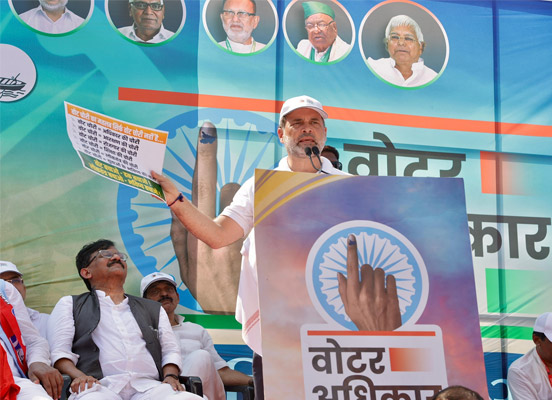
Against this backdrop, Rahul has once again turned to the streets, this time with his ‘Vote Chori Yatra’ in Bihar, to revive a party that has been gasping for breath in the state since its ouster in 1990. If the Bharat Jodo Yatra gave him a national platform to reposition himself as the conscience-keeper of democracy, the Bihar march has a sharper edge — it accuses the ruling dispensation of “stealing votes” and challenges the very legitimacy of India’s electoral system. By traversing 1,300 kilometers across 25 districts and addressing voters in 110 assembly constituencies, Rahul has placed Bihar at the heart of his political battle.
The Election Commission may be asking him to file affidavits to back his charges, while NDA leaders dismiss his rhetoric as wild and reckless. Yet, unperturbed, Rahul has done what Congress veterans failed to achieve in three decades: inject fresh energy into a moribund organization. Planned with meticulous precision and executed like a political-military campaign, the Yatra has not only unsettled the BJP but also placed Congress in a stronger position to bargain with its INDIA bloc allies, especially RJD’s Tejashwi Yadav, ahead of the crucial 2025 assembly polls.
A revival story in the making
The Congress has long been reduced to irrelevance in Bihar, surviving on the margins of coalition politics. Since being thrown out of power in March 1990, its organizational structure has withered and its vote share has shrunk alarmingly. Rahul’s 15-day Yatra has, at least temporarily, reversed that perception. By focusing on the emotive theme of “vote theft” rather than Hindutva or temple politics, he tapped into a simmering discontent that cuts across caste and class lines.
More importantly, the Vote Chori Yatra has rekindled faith among Congress cadres. Party workers, who had drifted to the RJD or even the BJP, now sense a possibility of revival. The Yatra’s impact is visible in the renewed enthusiasm at Congress offices, where once-deserted meetings are now drawing crowds. In terms of optics, Rahul’s connection with rural voters, students, and women has been far stronger than anticipated.
The ruling NDA in Bihar and at the Centre cannot afford to ignore the narrative Rahul has seeded. By framing the discourse around “stolen votes,” he has forced the BJP to defend the credibility of the electoral process — something it has prided itself on projecting as ironclad. The fact that the Election Commission was compelled to respond with demands for affidavits shows that Rahul’s charge struck a nerve.
BJP strategists worry that if the “vote theft” idea gains traction, it could undercut their Hindutva-driven messaging. For a party that has carefully cultivated an image of electoral invincibility, even the suggestion of malpractice can be corrosive. Nitish Kumar’s JD(U), too, finds itself squeezed: its credibility as a custodian of democracy is being questioned by both allies and adversaries.
Bihar: The crucible of opposition politics
If Madhavpur exposed alleged systemic flaws, Bihar has become the stage where Rahul must prove his capacity to convert rhetoric into political capital. The state, heading for assembly elections in 2025, is a psychological anchor for opposition politics. A strong performance here would strengthen the INDIA bloc’s hand for 2029; failure could unravel months of coordination. The stakes are even higher because 2026 will bring assembly polls in Assam, West Bengal, Tamil Nadu, and Puducherry, making Bihar not just a state contest but the opening act of a two-year cycle that could determine whether Rahul’s momentum solidifies into a national wave.
Seat-sharing and the INDIA bloc test
The immediate challenge is seat-sharing. The RJD remains the dominant opposition party in Bihar, and Tejashwi Yadav knows his bargaining power. But Rahul’s yatra has strengthened Congress’ claim for a more respectable share of seats in 2025. If Congress settles for too little, it risks demoralizing its cadres; if it demands too much, it could rupture the INDIA bloc’s fragile unity. How Rahul handles this negotiation will reveal whether his political instincts have matured.
Nationally, the Vote Chori Yatra also raises his stature within the INDIA bloc. Allies who once dismissed Congress as a junior partner now see a rejuvenated force capable of mobilizing masses. The yatra may even tilt the balance in leadership debates, with Rahul positioning himself as the natural challenger to Prime Minister Modi in 2029.
The larger democratic question
Beyond electoral arithmetic, the Bihar Yatra has raised uncomfortable questions about India’s democratic processes. By alleging that votes are being systematically stolen, Rahul is challenging not just the BJP but the very institutions that safeguard elections. Critics accuse him of undermining public trust; supporters argue he is exposing a dangerous reality.
This duality could be politically risky. If voters accept his charge, the BJP could lose moral authority; if they dismiss it as rhetoric, Rahul could face a backlash for crying wolf. Yet, by daring to broach the subject, he has opened a conversation that cannot be easily closed.
From Patna to 2029
The Vote Chori Yatra is more than just a state-level mobilization. It is Rahul Gandhi’s attempt to build a narrative arc from Bihar in 2025 to the Lok Sabha polls in 2029. If Congress can perform respectably in Bihar and then piggyback on favorable outcomes in Assam, West Bengal, Tamil Nadu, and Puducherry in 2026, the INDIA bloc could enter the next general election with renewed confidence.
But the road ahead is fraught with challenges. Congress must rebuild its organization in Bihar beyond the Yatra’s euphoria, invest in booth-level networks, and reclaim voters who deserted it decades ago. The RJD-Congress equation must be managed delicately, while ensuring the party does not return to its old habit of complacency once the spotlight fades.
Conclusion: A gamble with high stakes
Rahul Gandhi’s Vote Chori Yatra in Bihar is a political gamble with national implications. It is as much about reviving Congress in one of India’s most politically significant states as it is about shaping the opposition’s narrative against the BJP. By drawing a line from “vote theft” to the future of democracy, Rahul has shifted the terms of debate.
Whether this gamble pays off will depend on Bihar’s assembly elections in 2025. Victory would transform Congress from a marginal partner to a credible player within the INDIA bloc; defeat could reduce the Yatra to just another symbolic exercise. Either way, Bihar has once again become the crucible of Indian politics — or Rahul Gandhi has placed his bet squarely on its soil.

(K S Tomar is a senior political analyst and strategic affairs columnist based in Shimla)
The views expressed are not necessarily those of The South Asian Times