By Angad Singh Minhas
The narrow lens of economic utility
Education policy is often framed through economic metrics, with global institutions emphasizing its role in growth, jobs, and competitiveness. Aligning curricula with market demands is seen as key to national success. While this function is important, it is also shortsighted—reducing education to a utilitarian tool and ignoring its deeper role in building a just, resilient, and empowered citizenry. For a truly prosperous future, policy must move beyond economic utility and prioritize both equity and empowerment.
Education as a public good: Beyond the market's reach
A neoliberal view reduces education to a private benefit—a means to secure jobs, income, and status—treating it like a “supermarket” of credentials. But this ignores education’s wider social value. Framing education as a public good is more accurate: while individual degrees are private, the collective gains of an educated society—higher productivity, civic engagement, reduced crime, and stronger economies—are public goods shared by all. Since individuals usually consider only their private returns, markets alone underinvest in education. This makes government support not charity, but a necessary investment. Moreover, education also reduces inequality, improves health, promotes social cohesion, and strengthens democracy, showing that its value extends far beyond workforce training.
The imperative of equity: From equal access to equitable outcomes
Achieving a just education system requires shifting from equality to equity. Equality gives the same resources to all, but ignores different needs, like giving both a hungry child and a thirsty child only water. In education, this “one-size-fits-all” approach widens opportunity gaps since students begin from unequal conditions shaped by wealth, gender, ethnicity, or location. A fair system distributes resources based on need, ensuring equitable outcomes rather than just equal access. For example, a working student caring for siblings may need flexible deadlines, while another with tutoring needs different support. Equity-focused practices—like student-centered learning, alternative grading, and Universal Design for Learning (UDL)—demonstrate that personalized, accessible approaches raise success rates for underserved students. Equity is not a handout but a strategic way to ensure every learner has what they need to thrive.
The Power of empowerment: Cultivating the whole person
Education is more than technical training—it must cultivate the whole person by empowering students with agency, critical thinking, and lifelong learning. A narrow skills-based curriculum risks producing “brittle thinkers” who can execute but not innovate, especially in a world shaped by AI and automation. The most effective vocational programs combine technical skills with soft skills and practical experience. Arts and humanities play a vital role here, complementing STEM through a “Humanistic STEM” approach that blends technical knowledge with ethical reasoning, empathy, and communication. These disciplines provide a global perspective, creativity, and the ability to tackle complex societal challenges. Undervaluing them leads to “intellectually fragile professionals” and widens social inequities, as marginalized communities lose access to cultural and critical resources. A just, future-ready education system must therefore embrace an interdisciplinary model that balances technical competence with humanistic insight.
Towards a holistic framework: Policy recommendations for a shared future
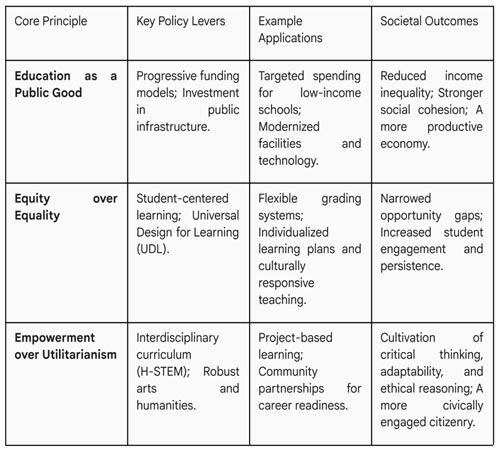
The path forward requires a new policy framework that rejects the false dichotomy between economic and social goals. This framework must integrate the principles of public good, equity, and empowerment to create an education system that serves the whole person and the whole society. The following policy levers offer a pathway to this more holistic approach.
Reforming funding for true equity
The current funding models in many places perpetuate existing disparities. To correct this, governments must implement progressive funding models that direct more resources to underserved schools and communities to address systemic inequalities in infrastructure, technology, and teacher quality. Research shows that increased expenditures on education have a significant effect on reducing income inequality and that retaining effective teachers in low-performing schools is one of the most powerful levers for improving student achievement.
Fostering a humanistic and adaptive curriculum
A new curriculum must be designed to cultivate adaptability and agency. This involves curriculum reform that integrates technical skills with arts, humanities, and social-emotional learning (SEL). By supporting student-centered, project-based, and hands-on learning and by providing students with choices in their assignments, policy can help them develop a sense of ownership over their education. This prepares students not just for the technical demands of the workforce but also for the critical, ethical, and communicative challenges of a modern society, while also cultivating the "soft skills" identified as critical for long-term career success.
Building community-wide partnerships
Effective policy must build "two-way bridges" between students and the world of work. This involves investing in formal partnerships between schools, businesses, non-profits, and universities to offer real-world, experiential learning and networking opportunities. Such an approach ensures that learning is "real and relevant" and, most importantly, provides equitable access to the professional networks and social capital that are often inaccessible to students from disadvantaged backgrounds. This can be a key strategy for "breaking the cycles of poverty".
The following table synthesizes this framework for a holistic education policy:
Conclusion: Investing in people, not just a pipeline
The purpose of education goes beyond economic utility—it is a public good essential for democracy, justice, and social well-being. A system focused only on workforce preparation neglects deeper social challenges. True progress comes from educating all individuals to be critical thinkers, compassionate citizens, and lifelong learners. Investing in equity- and empowerment-driven education is both ethical and strategic, fostering not just prosperity but also resilience, justice, and humanity. A nation’s future lies less in GDP and more in the collective capacity of its people to innovate, collaborate, and thrive together.
Angad Singh Minhas is a student of Political Science and Economics at CHRIST (Deemed to be University) Delhi NCR.
The views expressed are not necessarily those of The South Asian Times