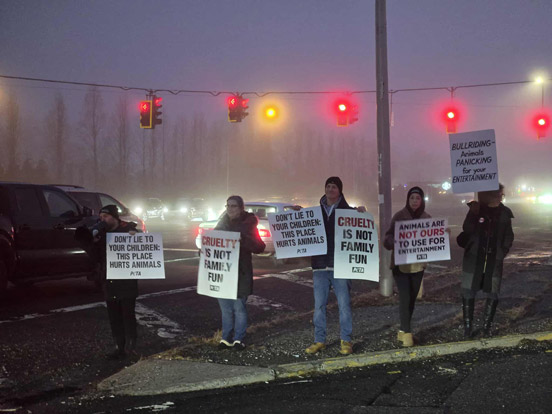
Revered throughout India, bovines are among nature’s most peaceful herbivores. Yet at rodeos such as those run by Professional Bull Riders—which my organization, Humane Long Island, protested outside Nassau Veterans Memorial Coliseum on Long Island this past weekend—these gentle giants are exploited in a bloodsport. Bulls are regularly deprived of food and water before events and subjected to practices designed to provoke violent bucking, forcing them to react out of fear and distress.
The federal Animal Welfare Act provides no protection for animals used in rodeos. As bulls struggle to throw riders from their backs, they can suffer severe injuries, including deep internal bruising, broken bones, torn ligaments, ripped tendons, and muscle damage. When they become too old, exhausted, or injured to continue performing, many are discarded and ultimately sent to slaughter. On the very day we demonstrated on Long Island, a bull named Man Eater was killed at another Professional Bull Riders event in Little Rock after suffering a broken leg while attempting to throw a rider from his back.
Rodeos are dangerous for humans as well. Last year, a 24-year-old bull rider, Dylan Grant, died after being trampled by a bull in Texas. A 22-year-old named Naveen Kumar was gored to death during Jallikattu, a similar spectacle on the other side of the world in which participants attempt to grab the hump of frightened bulls and hold on as long as possible. Because of the danger and cruelty involved, Jallikattu was banned for several years in India. But since it was permitted again in Tamil Nadu in 2017, at least 134 men and children—and 45 bulls—have reportedly been killed. On January 16, 2025 alone, seven people, including six spectators, died at jallikattu events; over the same three-day period, three bulls also died.
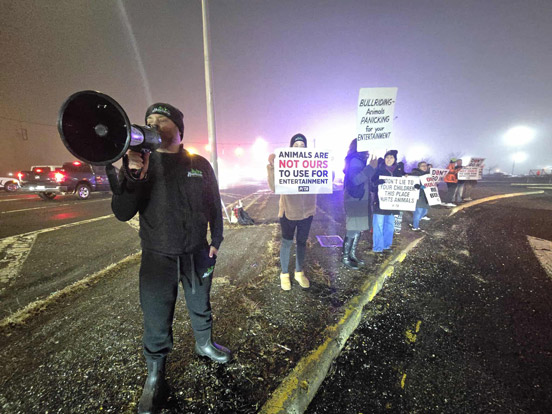
(Photo courtesy: John Di Leonardo)
Communities closer to home have begun pushing back. The Town of Southampton on Long Island effectively banned rodeos by prohibiting the use of electric prods, flank straps, sharpened spurs, and other devices used to force bulls to buck and submit. In New York City, lawmakers came close to similar reforms last year, when a majority of councilmembers supported Intro 1255. The legislation would prohibit calf roping—where riders on horseback lasso a terrified calf, slam the animal to the ground, and tie their legs together—as well as the use of electric prods and flank straps in rodeos.
The measure was never scheduled for a vote by former Council Speaker Adrienne Adams before the end of the last session, but it is expected to be reintroduced in 2026 with support from the council’s new Animal Welfare Caucus.
For this week’s Anuvrat, or small vow, I invite readers to speak out against animal cruelty—especially cruelty toward bulls. If you live in New York City, contact your City Councilmember and urge them to support a ban on bull riding. If you’re on Long Island, ask Nassau Veterans Memorial Coliseum to stop hosting events that harm animals. And if you’re in India, consider getting involved with PETA India to help end Jallikattu.
You can also help protect bovines through your everyday choices. The dairy industry relies on the exploitation of cows—often involving forced impregnation, separation of calves from their mothers, and eventual slaughter—making it inherently harmful to animals. Choosing a vegan lifestyle spares the lives of nearly two hundred animals every year.
John Di Leonardo is the founding director of Humane Long Island. He was previously the Senior Manager of Grassroots Campaigns and Animals in Entertainment Campaigns for People for the Ethical Treatment of Animals (PETA). He has a Master's degree in Anthrozoology from Canisius College. He also earned a graduate certificate in Jain Studies from the International School of Jain Studies (ISJS) in India. John can be reached at [email protected].